

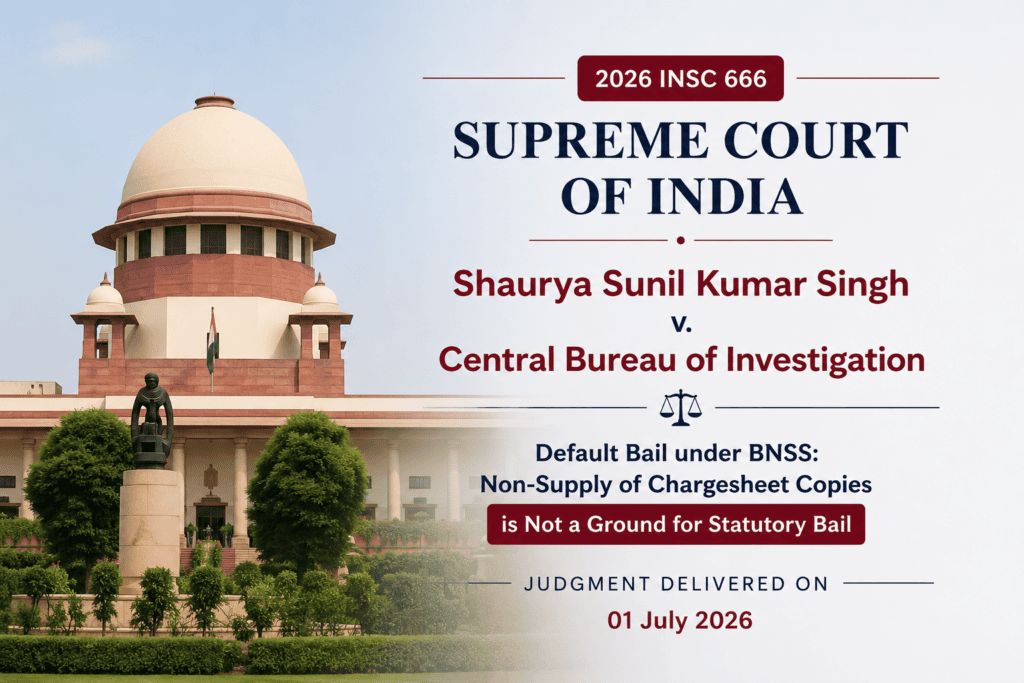
Supreme Court Clarifies Default Bail Under BNSS: Non-Supply of Chargesheet Copies Does Not Confer Statutory Bail
Court: Supreme Court of India
Case: Shaurya Sunil Kumar Singh v. Central Bureau of Investigation
Citation: 2026 INSC 666
Date of Judgment: 1 July 2026
Bench: Justice Sanjay Karol and Justice Nongmeikapam Kotiswar Singh
Area of Law: Criminal Law | BNSS | Default Bail | Investigation | Personal Liberty
Source:
Case Summary
In this landmark judgment, the Supreme Court settled an important question under the Bharatiya Nagarik Suraksha Sanhita, 2023 (BNSS):
Can an accused claim default (statutory) bail merely because copies of the chargesheet and accompanying documents were not supplied within the prescribed period, even though the chargesheet itself was filed within time?
The Court answered No.
The Court held that filing of the police report (chargesheet) within the statutory period extinguishes the accused’s right to default bail. Delay in supplying copies of the chargesheet under Sections 193(8) and 230 BNSS is only a procedural lapse and does not revive the statutory right to default bail.
Facts of the Case
The CBI registered an FIR regarding a large cyber fraud involving fake KYC documents, mule bank accounts, phishing scams, digital arrest frauds, and illegal transfer of approximately ₹3.81 crore.
The appellant was alleged to have:
- Transported cheque books, ATM cards and SIM cards used in the conspiracy;
- Assisted the principal accused with logistics;
- Facilitated financial transactions;
- Participated in the criminal conspiracy.
The appellant was arrested on 13 July 2025.
The CBI filed the chargesheet on 2 September 2025, which was within the statutory period.
However, copies of the chargesheet and documents were supplied later.
The accused claimed that because copies were not supplied within time, he acquired an indefeasible right to default bail under Section 187(3) BNSS.
The Special Court and Bombay High Court rejected the plea, following which the matter reached the Supreme Court.
Legal Issue
Whether non-filing or delayed supply of copies of the chargesheet under Section 193(8) BNSS entitles an accused to default bail under Section 187(3) BNSS, even when the chargesheet itself has been filed within the prescribed period?
Relevant Statutory Provisions
BNSS
- Section 187(3) – Default (Statutory) Bail
- Section 193(3) – Filing of Police Report
- Section 193(8) – Filing sufficient indexed copies of the police report for supply to the accused
- Section 230 – Supply of police report and documents within fourteen days
Arguments of the Appellant
The appellant contended that:
- Section 193(8) BNSS is mandatory.
- Unless copies of the police report are filed and supplied, investigation cannot be treated as complete.
- Since copies were not supplied within time, the right to default bail continued.
Arguments of the CBI
The CBI argued that:
- The chargesheet had already been filed within the statutory period.
- Section 187 BNSS concerns only timely filing of the police report.
- Delay in supplying copies cannot invalidate the chargesheet.
- At best, it is a procedural irregularity.
Findings of the Supreme Court
The Supreme Court rejected the appellant’s contention and held that:
1. Default bail depends only on timely filing of the chargesheet.
Once the police report complying with Section 193(3) BNSS is filed within the statutory period, the right to default bail automatically comes to an end.
2. Section 193(8) BNSS is procedural.
The requirement to file additional copies for supply to the accused does not determine whether investigation is complete.
Failure to comply with Section 193(8) does not invalidate the police report.
3. Delay in supplying documents does not revive statutory bail.
Even if copies are supplied later under Section 230 BNSS, the accused cannot seek default bail once a valid chargesheet has already been filed.
4. Regular bail and default bail are different remedies.
After filing of the chargesheet, the accused may seek regular bail on merits, but cannot invoke statutory/default bail merely due to procedural delay in supply of documents.
Principles Reaffirmed
The Court reiterated several settled principles:
- Default bail is an indefeasible right flowing from Article 21.
- The right exists only until the chargesheet is filed within the prescribed period.
- Filing of a valid police report extinguishes that right.
- Procedural defects in accompanying documents do not invalidate the chargesheet.
- Courts should distinguish between investigation defects and procedural irregularities.
Important Precedents Relied Upon
The Court relied upon:
- Saravanan v. State (2020)
- Fakhrey Alam v. State of Uttar Pradesh (2021)
- State v. T. Gangi Reddy (2023)
- Judgebir Singh v. NIA (2023)
- CBI v. Kapil Wadhawan (2024)
- CBI v. R.S. Pai (2002)
- Narendra Kumar Amin v. CBI (2015)
- Rakesh Kumar Paul v. State of Assam (2017)
- Bikramjit Singh v. State of Punjab (2020)
Final Decision
The Supreme Court:
- Dismissed the appeal.
- Affirmed the Bombay High Court’s judgment.
- Held that non-supply or delayed supply of chargesheet copies is not a ground for default bail.
- Clarified that the appellant is free to pursue regular bail on its own merits.
Key Takeaways
- Filing the chargesheet within 60/90 days is sufficient to defeat a claim for default bail.
- Section 193(8) BNSS is procedural and does not affect the validity of the police report.
- Delay in supplying copies under Section 230 BNSS does not create a fresh right to statutory bail.
- After a valid chargesheet is filed, the appropriate remedy is an application for regular bail.
- The judgment provides much-needed clarity on the interplay between Sections 187, 193 and 230 of the BNSS.
Editorial Note (Rex Juris)
This judgment is one of the earliest and most significant Supreme Court interpretations of the BNSS, 2023 on the scope of default bail. It reinforces that the constitutional protection of personal liberty under Article 21 must be balanced with the statutory framework governing criminal investigations. By distinguishing between substantive non-compliance (failure to file a chargesheet) and procedural irregularities (delay in supplying copies), the Court ensures that statutory bail remains a safeguard against investigative delay rather than a remedy for every procedural lapse. This decision will serve as an important precedent for criminal practitioners and trial courts interpreting the new criminal laws.
About The Author

More Stories
SC: Assessment Committee Not Bound to Average APR/PMS and Work Report Marks for Promotion
Supreme Court Quashes Advocate’s Blacklisting in IBA Caution List: Banks Cannot Punish Lawyers for Alleged Professional Negligence
Supreme Court Restores Widow’s Property Rights: Unexplained Suspicious Circumstances Render Registered Will Invalid