

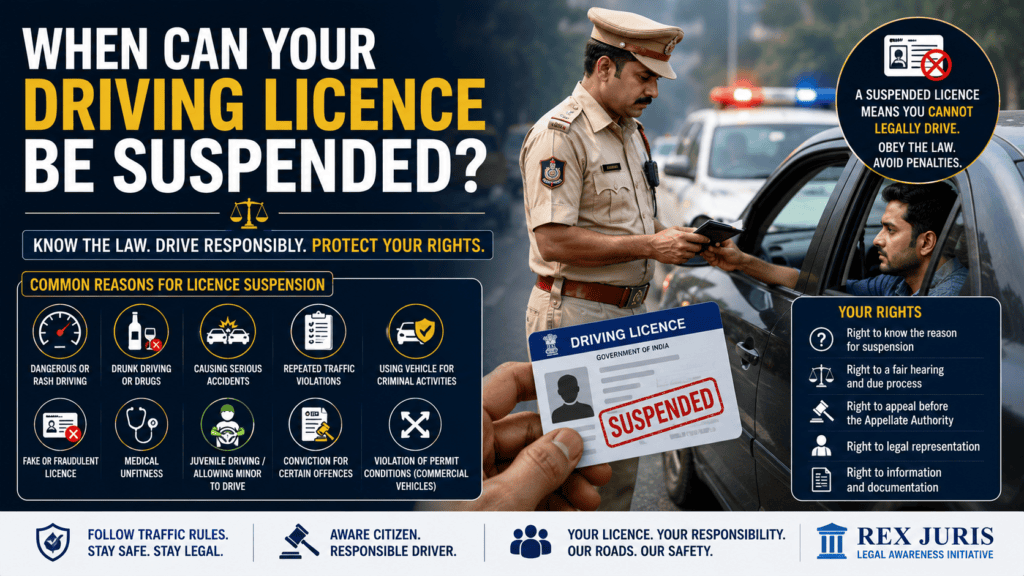
A Driving Licence is more than just an identity document—it is a legal authorization granted by the licensing authority to operate a motor vehicle. This privilege carries important responsibilities. Violations of traffic laws, dangerous driving behaviour, or certain criminal offences may result in the suspension of your Driving Licence.
Many drivers mistakenly believe that every traffic violation automatically leads to licence suspension. In reality, a Driving Licence can be suspended only in circumstances provided under the Motor Vehicles Act, 1988, the Central Motor Vehicles Rules, applicable State Rules, and subject to the prescribed legal procedure.
This article explains when a Driving Licence can be suspended, who has the authority to suspend it, the legal procedure involved, your rights, and the remedies available.
What Does Suspension of a Driving Licence Mean?
Suspension of a Driving Licence means that the licence holder is temporarily prohibited from driving a motor vehicle for a specified period.
During the suspension period:
- You cannot legally drive any vehicle for which the licence is suspended.
- Driving despite suspension may result in further legal consequences.
- The suspension may be temporary or, in serious cases, followed by cancellation or disqualification in accordance with law.
Who Has the Authority to Suspend a Driving Licence?
A Driving Licence may be suspended by the Licensing Authority or other competent authority empowered under the Motor Vehicles Act.
Traffic police may, in certain circumstances permitted by law, seize or impound the licence and initiate proceedings, but they do not automatically suspend the licence merely by issuing a challan.
The final decision is ordinarily taken through the prescribed legal process by the competent authority.
Circumstances Where Your Driving Licence May Be Suspended
1. Dangerous or Rash Driving
Driving in a manner that endangers human life or public safety may result in suspension proceedings.
Examples include:
- Excessive speeding.
- Driving against traffic.
- Reckless overtaking.
- Street racing.
- Ignoring repeated traffic signals.
- Dangerous manoeuvres.
2. Driving Under the Influence of Alcohol or Drugs
Driving after consuming alcohol or narcotic substances is a serious offence.
If established under applicable law, the licensing authority may suspend the Driving Licence depending on the nature and seriousness of the violation.
3. Repeated Traffic Violations
Habitual offenders who repeatedly violate traffic laws may face stricter action, including suspension of their Driving Licence in accordance with applicable legal provisions.
Examples include repeated:
- Overspeeding.
- Signal jumping.
- Helmet violations.
- Seat belt violations.
- Mobile phone use while driving.
4. Causing Serious Road Accidents
Where negligent or dangerous driving results in serious injury or death, the licence holder may face suspension proceedings in addition to criminal prosecution and civil liability.
5. Juvenile Driving Cases
Allowing a minor without a valid Driving Licence to drive a motor vehicle is a serious offence.
Depending on the circumstances and applicable law, action may be taken against the registered owner, guardian, or person responsible, including proceedings affecting the vehicle’s registration or licence where permitted.
6. Using a Vehicle for Criminal Activities
If a vehicle is used in connection with offences such as illegal transportation, smuggling, or other criminal acts, the driver may face action affecting the Driving Licence in accordance with law.
7. Fraudulent Driving Licence
A licence obtained through:
- False documents
- Impersonation
- Misrepresentation
- Fraudulent means
may be suspended or cancelled after due legal process.
8. Medical Unfitness
A licence holder may face suspension if they are found medically unfit to drive safely due to a condition that significantly affects their ability to operate a vehicle.
Such decisions are ordinarily based on the applicable legal procedure and, where required, medical assessment.
9. Conviction for Certain Offences
Conviction by a competent court for specified offences under traffic or criminal law may result in suspension or disqualification from holding a Driving Licence, depending on the applicable statutory provisions.
Difference Between Seizure and Suspension
Many drivers confuse these two terms.
Seizure
- Temporary taking of the licence by an authorized officer.
- Usually done during enforcement proceedings.
- Does not automatically mean the licence is suspended.
Suspension
- Formal legal order by the competent authority.
- Temporarily withdraws the legal right to drive.
- Takes effect after the prescribed legal process.
Can Traffic Police Suspend Your Licence on the Spot?
Generally, No.
Traffic police may, in circumstances authorized by law:
- Issue a challan.
- Seize or impound the licence.
- Report the matter to the Licensing Authority.
The authority empowered under law decides whether suspension is warranted after following the prescribed procedure.
Procedure Before Suspension
Although procedures may vary depending on the facts and applicable law, the process generally involves:
- Detection of the alleged offence.
- Preparation of the necessary enforcement records.
- Submission of the matter to the competent authority where required.
- Consideration of the evidence and applicable legal provisions.
- Issuance of an order in accordance with law.
In many situations, principles of natural justice require that the affected person be given an opportunity to present their case before adverse action is taken.
Can You Challenge the Suspension?
Yes.
A person whose Driving Licence has been suspended may have legal remedies available, depending on the circumstances.
These may include:
- Filing a representation before the Licensing Authority.
- Seeking review where permitted.
- Filing an appeal under the applicable statutory provisions.
- Approaching the competent court where appropriate.
Legal advice should be obtained before initiating proceedings.
What Should You Do If Your Licence Is Suspended?
If your licence has been suspended:
- Do not drive during the suspension period.
- Obtain a copy of the suspension order.
- Understand the reasons for the action.
- Preserve all relevant documents.
- Seek legal advice if you believe the suspension is unlawful or unjustified.
- Comply with any lawful directions issued by the competent authority.
Driving while the suspension remains in force may result in additional penalties or prosecution.
How to Avoid Suspension of Your Driving Licence
Follow these practical precautions:
- Always obey traffic signals.
- Wear a helmet or seat belt as required.
- Never drink and drive.
- Do not use a mobile phone while driving.
- Follow speed limits.
- Keep your vehicle legally compliant.
- Carry valid vehicle documents.
- Avoid aggressive or reckless driving.
- Stay updated with changes in traffic laws.
Responsible driving is the best protection against licence suspension.
Frequently Asked Questions (FAQs)
Can my licence be suspended for overspeeding?
Repeated or serious instances of overspeeding may lead to suspension proceedings where authorized by law, depending on the facts and applicable provisions.
Can traffic police cancel my Driving Licence?
No. Traffic police may take enforcement action permitted by law, but cancellation or suspension of a Driving Licence generally requires action by the competent authority following the prescribed procedure.
Can I drive if my licence has been seized but no suspension order has been passed?
The legal consequences depend on the circumstances under which the licence was seized and the applicable statutory provisions. You should seek clarification from the concerned authority and avoid driving if prohibited by law.
Will every challan lead to licence suspension?
No. Most routine traffic violations result in fines or other statutory enforcement measures. Licence suspension is generally reserved for specified offences or repeated violations where the law so provides.
Conclusion
A Driving Licence is both a legal privilege and a public responsibility. The law provides for suspension only in specific circumstances and through a prescribed legal process. Traffic police cannot arbitrarily suspend a licence merely because a driver has been stopped or issued a challan. By understanding the law, respecting traffic rules, and driving responsibly, motorists can protect both their legal rights and the safety of others on the road.
Disclaimer: This article is intended solely for educational and legal awareness purposes and does not constitute legal advice. The suspension or cancellation of a Driving Licence depends on the specific facts, the Motor Vehicles Act, 1988, the Central Motor Vehicles Rules, applicable State Rules, judicial decisions, and orders of the competent authority. Readers should consult a qualified advocate for advice regarding any specific legal issue.
About The Author

More Stories
Rights of Citizens During Traffic Stops in India: What Every Driver Should Know
Can Traffic Police Seize Your Vehicle in India? Know the Law, Your Rights, and Legal Remedies
What Police Can Legally Ask During Vehicle Checking in India? Know Your Rights and Duties