

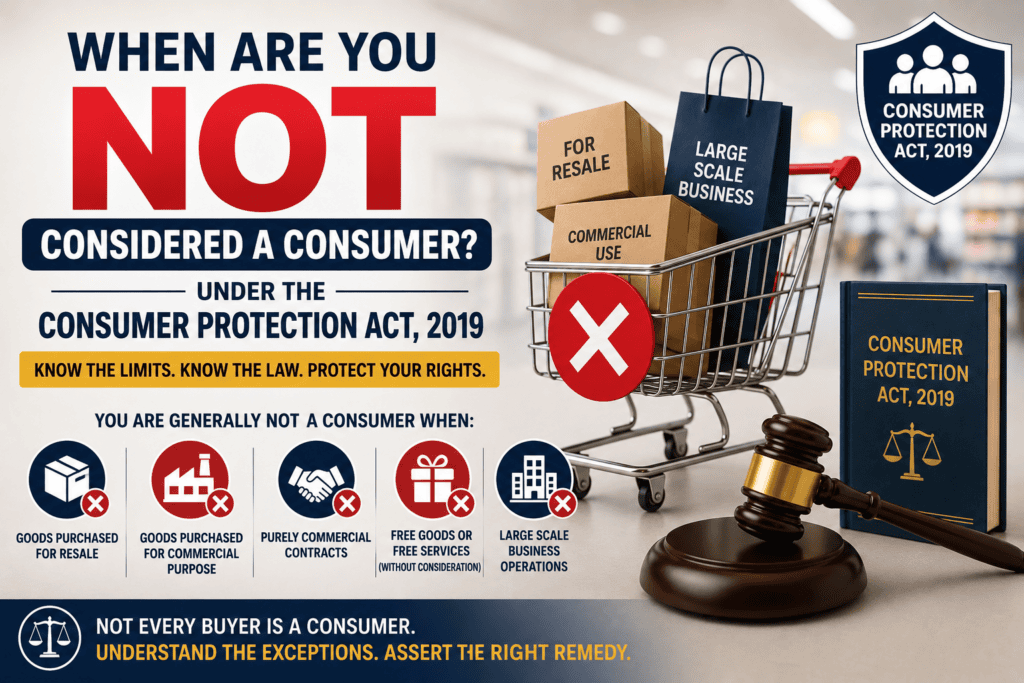
Many people assume that every buyer is automatically protected under the Consumer Protection Act, 2019. However, this is not always true. While the Act provides strong safeguards for genuine consumers, it also sets clear limits on who can seek relief under consumer law.
If you purchase goods for resale, large-scale commercial purposes, or receive services free of charge in certain circumstances, you may not qualify as a “consumer” under the Act.
Understanding these exclusions is just as important as knowing your consumer rights. It helps you determine whether you can file a complaint before a Consumer Commission or whether another legal remedy may be more appropriate.
Why Does the Law Exclude Certain Persons?
The Consumer Protection Act is intended to protect ordinary consumers who buy goods or hire services for personal use or livelihood—not businesses engaged in commercial trading or profit-making activities.
Commercial disputes between businesses are generally dealt with under other applicable laws and contractual remedies, rather than consumer law.
Situations Where You Are Generally NOT Considered a Consumer
1. Goods Purchased for Resale
If you purchase goods with the intention of selling them again for profit, you are generally not considered a consumer.
Example
A wholesaler purchases 500 mobile phones from a manufacturer to sell them in retail shops.
Since the purchase is for resale, the wholesaler is ordinarily not treated as a consumer under the Act.
More Examples
- Buying garments for resale.
- Purchasing grocery items for a retail business.
- Buying electronic goods to sell through an online store.
- Importing products for commercial distribution.
2. Goods Purchased for Commercial Purpose
A person who purchases goods for a commercial purpose is generally excluded from the definition of a consumer.
Commercial purpose usually refers to purchases made for business operations, manufacturing, or profit-generating activities on a commercial scale.
Example
A manufacturing company purchases heavy industrial machinery for its factory.
The machinery is used to produce goods for commercial sale.
The company would generally not be considered a consumer for this purchase.
Examples of Commercial Purchases
Generally excluded purchases may include:
- Industrial machinery
- Factory equipment
- Commercial printing machines
- Restaurant kitchen equipment
- Bulk manufacturing tools
- Commercial vehicles purchased for fleet operations
- Goods purchased for trading businesses
Each case depends on its specific facts and the purpose of the purchase.
Important Exception: Self-Employment
One of the most significant exceptions under the Consumer Protection Act relates to self-employment.
A person who purchases goods exclusively for earning a livelihood through self-employment may still qualify as a consumer.
The law recognizes that such individuals are not running large commercial enterprises but are using the goods personally to support themselves.
Examples
A tailor purchases one sewing machine to stitch clothes personally.
A taxi driver buys one car to drive himself.
A photographer purchases one professional camera to provide photography services personally.
A carpenter purchases woodworking tools for his own work.
These individuals may continue to enjoy consumer protection because the goods are used for earning a livelihood through personal effort rather than for large-scale commercial activity.
3. Free Goods or Free Services
The Consumer Protection Act generally applies where goods or services are obtained for consideration (payment).
If goods or services are provided completely free of charge, the recipient may not fall within the definition of a consumer under the Act, depending on the facts and the applicable legal principles.
Examples
- A free promotional gift distributed without purchase.
- A service provided entirely without charge.
- A complimentary product received during an event.
However, if the cost of the “free” item is effectively included in the price paid for another product or service, different legal considerations may arise.
4. Purely Commercial Contracts
Disputes arising solely from commercial agreements between businesses may not fall within the scope of consumer law.
Examples include:
- Supply agreements between companies.
- Wholesale trading disputes.
- Distribution agreements.
- Commercial franchise disputes.
- Business procurement contracts.
Such disputes may need to be resolved under contract law or other applicable legal frameworks.
Consumer vs Non-Consumer: Practical Examples
| Situation | Consumer? |
|---|---|
| Buying a refrigerator for home | ✔ Yes |
| Purchasing groceries for family use | ✔ Yes |
| Buying one laptop for personal study | ✔ Yes |
| Purchasing one sewing machine for self-employment | ✔ Yes |
| Buying one taxi to drive personally for livelihood | ✔ Yes |
| Purchasing 500 mobile phones for resale | ✘ Generally No |
| Buying industrial machinery for a factory | ✘ Generally No |
| Purchasing goods for wholesale trading | ✘ Generally No |
| Receiving a completely free promotional product | Generally No, depending on the circumstances |
Why the Self-Employment Exception Matters
Many small business owners mistakenly believe they are automatically excluded from consumer protection.
That is not always correct.
The key distinction is whether the goods are used:
- Personally to earn a livelihood through self-employment; or
- As part of a larger commercial or profit-making enterprise.
Consumer Commissions examine the facts of each case to determine whether the self-employment exception applies.
Practical Tips Before Filing a Consumer Complaint
Before approaching a Consumer Commission, ask yourself:
- Did I pay for the goods or services?
- Were the goods purchased for personal use?
- Were they purchased solely for earning my livelihood through self-employment?
- Were they bought for resale or large-scale commercial use?
- Do I have invoices, receipts, warranty documents, or payment records?
The answers to these questions can help determine whether your complaint falls within the Consumer Protection Act.
Frequently Asked Questions (FAQs)
Can a shop owner file a consumer complaint for goods purchased for resale?
Generally, no. Goods purchased for resale are ordinarily excluded from the definition of a consumer.
Is every business excluded from consumer protection?
Not necessarily. The nature and purpose of the purchase are important. In some situations, a business may qualify as a consumer if the purchase is not for resale or a commercial purpose.
Is a self-employed person protected?
Yes. A person purchasing goods exclusively to earn a livelihood through self-employment may still qualify as a consumer.
Are free services covered under the Consumer Protection Act?
Services provided entirely free of charge are generally outside the scope of the Act, though each case depends on its specific facts and the applicable legal principles.
Can I file a complaint if I purchased machinery for my factory?
If the machinery was purchased for a commercial manufacturing business, you are generally not regarded as a consumer under the Act for that transaction.
Common Misconceptions
Myth: Every buyer is a consumer.
Reality: Purchases for resale or commercial purposes are generally excluded, subject to statutory exceptions.
Myth: Small business owners never have consumer rights.
Reality: Self-employed individuals who purchase goods exclusively to earn their livelihood may still qualify as consumers.
Myth: Free products always give rise to consumer rights.
Reality: Completely free goods or services are generally outside the scope of the Consumer Protection Act, though specific circumstances can affect the legal position.
Conclusion
The Consumer Protection Act, 2019 is designed to protect genuine consumers, but it does not cover every commercial transaction. Understanding when a person is not considered a consumer is essential before pursuing a claim under the Act.
If your purchase was made for resale, large-scale commercial use, or involved completely free goods or services, the Consumer Protection Act may not apply. However, the law also recognizes the needs of self-employed individuals who rely on goods to earn their livelihood.
Knowing these distinctions can help you choose the appropriate legal remedy and avoid unnecessary litigation.
Disclaimer
This article is intended solely for general legal awareness and educational purposes. It does not constitute legal advice or create an advocate–client relationship. Whether a person qualifies as a consumer depends on the specific facts of each case and the applicable law. Readers should consult a qualified advocate for advice tailored to their circumstances.
About The Author

More Stories
Who is a Consumer under the Consumer Protection Act, 2019?
Know Your Six Consumer Rights in India