

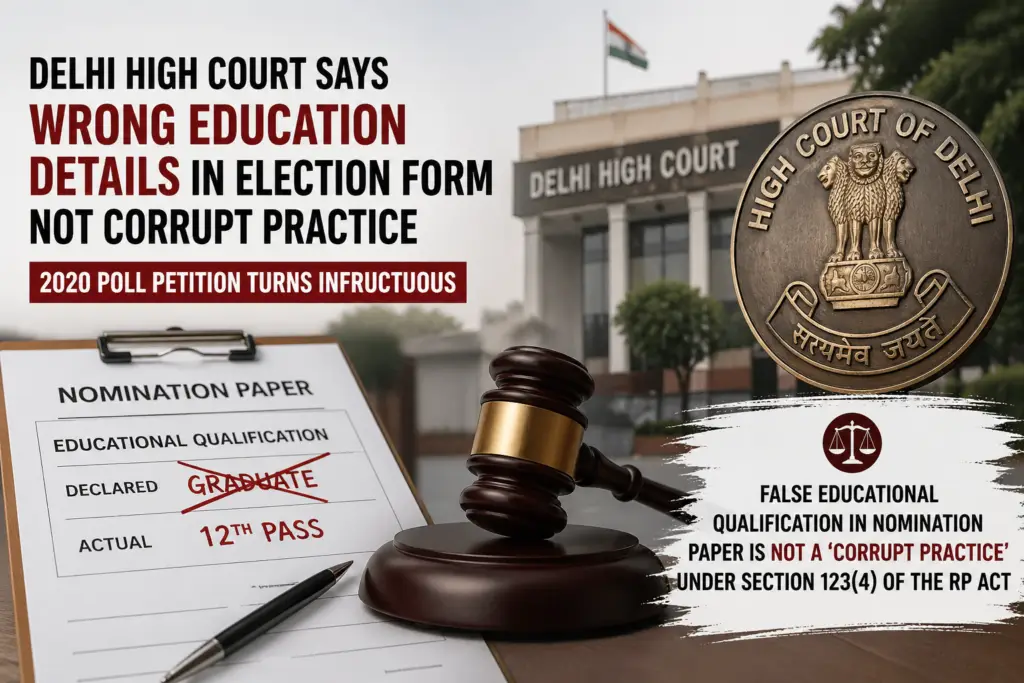
Delhi High Court Settles Key Question in Election Law — Declares Nand Ram Bagri Ruling on Section 123(4) as Not Good Law
Published: 25 April 2026 | Decision Date: 24 April 2026 | Reported by: RexJuris Editorial Desk
| Case at a Glance |
| Case Title | Yogender Chandolia v. Vishesh Ravi & Ors. |
| Case Number | EL.PET. 10/2020, I.A. 8728/2020 & I.A. 11988/2020 |
| Court | High Court of Delhi |
| Bench | Justice Dinesh Mehta & Justice Vinod Kumar |
| Decision Date | 24th April, 2026 |
| Acts Involved | Representation of the People Act, 1951 — Sections 123(2), 123(4), 83, 100(1)(b), 100(1)(d) |
| Key Precedents | Nand Ram Bagri v. Jai Kishan (2013 SCC Online Del 1826); Ajmera Shyam v. Smt. Kova Laksmi & Ors. (2025 SCC OnLine SC 1723); M.J. Jacob v. A. Narayanan & Ors. (CA 3611/2008) |
| Introduction |
In a significant ruling that will shape election law jurisprudence in India, a Division Bench of the Delhi High Court comprising Justice Dinesh Mehta and Justice Vinod Kumar has held that a candidate’s false declaration regarding his own educational qualification in the nomination form or affidavit (Form 26) does not constitute a ‘corrupt practice’ within the meaning of Section 123(4) of the Representation of the People Act, 1951 (“RP Act”). The judgment was pronounced on 24th April, 2026 in the matter of Yogender Chandolia v. Vishesh Ravi & Ors. (EL.PET. 10/2020).
The ruling arose from an election petition challenging the victory of Vishesh Ravi from Assembly Constituency-23, Karol Bagh in the 2020 Delhi Legislative Assembly elections. The Bench was exercising reference jurisdiction, after a learned Single Judge referred the legal question to a larger bench due to a conflict with an earlier coordinate bench ruling — Nand Ram Bagri v. Jai Kishan (2013 SCC Online Del 1826).
| Background & Facts |
The petitioner, Yogender Chandolia, filed the election petition alleging that the returned candidate — Vishesh Ravi — had furnished false particulars regarding his educational qualification in his nomination papers and affidavit (Form 26) filed for the 2020 elections. The specific allegation was that Ravi had declared himself as having passed Class 10th from NIOS (National Institute of Open Schooling) in the year 2003, but NIOS records purportedly showed that while he had enrolled in May 2002, he had not actually appeared in the Class 10 examination.
The petitioner further alleged that similar false declarations had been made in the elections of 2013 and 2015. It was contended that such misrepresentation was made with a motive to mislead and induce voters, thereby materially affecting the election result in the respondent’s favour and prejudicing the prospects of the petitioner and other contesting candidates.
The entire case of the petitioner was grounded on Section 123(4) of the RP Act — which deals with corrupt practice in the form of publication of false statements — and not under Section 123(2), which deals with ‘undue influence’. The petitioner also sought the respondent’s disqualification for six years under Section 8A of the RP Act, along with prosecution under Section 125A of the RP Act.
| The Legal Question Before the Court |
The Division Bench was tasked with answering a two-fold reference:
(i) Whether filing a false declaration about one’s own educational qualification in a nomination form/affidavit amounts to a ‘corrupt practice’ under Section 123(4) of the RP Act; and
(ii) Whether the election petition, arising from the 2020 Delhi Assembly elections (the term of which had already expired following fresh elections in 2025), had been rendered infructuous.
| Court’s Analysis: Interpreting Section 123(4) |
The Bench undertook a rigorous textual analysis of Section 123(4) of the RP Act, which reads — in essence — that it is a corrupt practice for any candidate or his agent to publish any false statement of fact in relation to the personal character or conduct of any candidate, being a statement reasonably calculated to prejudice the prospects of that candidate’s election.
The Court identified four essential ingredients of Section 123(4):
| (i) | There must be a publication by a candidate or his agent. |
| (ii) | Such publication must be false or made believing it to be false or not true. |
| (iii) | The publication must relate to the personal character or conduct of any candidate. |
| (iv) | Such statement must be calculated to prejudice the prospects of that candidate’s election. |
On examining these ingredients collectively, the Court held that the provision unambiguously targets false statements made about another candidate — not about oneself. The expressions “any candidate” and “that candidate’s election” in the statute clearly contemplate a scenario where a candidate publishes falsehoods about an opponent, not where a candidate makes a claim about his own personal attributes or qualifications.
“By no stretch of imagination, a candidate can/would level allegation against himself, that too with a view to prejudice his own prospects. The use of expression ‘in relation to personal character or conduct of any candidate’ so also, the expression ‘reasonably calculated to prejudice the prospects’ and expression ‘that candidate’s election’ leaves no room for doubt that the assertion made by the petitioner, even if taken to be at its face value, cannot be brought within the sweep and scope of sub-section (4).”
The Bench further held that filing a declaration in a nomination form or affidavit would not, by itself, constitute “publication” within the meaning of Section 123(4). Referring to Black’s Law Dictionary, the Court noted that “publication” implies making something known to the public at large — an act distinctly different from filing a form before a Returning Officer in prescribed administrative proceedings.
| Overruling Nand Ram Bagri: A Critical Distinction |
A critical aspect of the judgment was the Court’s treatment of the earlier Single Judge ruling in Nand Ram Bagri v. Jai Kishan (2013 SCC Online Del 1826). In that case, the court had taken the view that incorrect educational particulars in a nomination form could constitute corrupt practice. The learned Single Judge who made the reference had doubted its correctness, especially in the light of the Supreme Court’s subsequent ruling in Ajmera Shyam v. Smt. Kova Laksmi & Ors. (2025 SCC OnLine SC 1723).
The Division Bench drew a crucial factual distinction: Nand Ram Bagri was litigated under both Section 123(2) (undue influence) and Section 123(4), whereas in the present case, the petitioner had confined his pleadings exclusively to Section 123(4). The Court held that since the foundational premise was different, Nand Ram Bagri was factually inapplicable. The Bench added:
“We also hold that the allegation of furnishing false declaration and documents in relation to educational qualification of the candidate himself/herself does not constitute a corrupt practice within the meaning of sub Section (4) of Section 123 of the Act of 1951. And the judgment rendered in Nand Ram Bagri (supra) to the extent it holds that wrong mentioning or incorrect statement given in the nomination form is corrupt practice within meaning of Section 123(4) is not good law.”
This declaration — that Nand Ram Bagri is “not good law” to the extent it equated nomination form misstatements with corrupt practice under Section 123(4) — is perhaps the most far-reaching aspect of this judgment and will likely be cited in election disputes across the country.
| Impact of Ajmera Shyam: The Evolving Standard |
The Court also took note of the Supreme Court’s recent authoritative ruling in Ajmera Shyam v. Smt. Kova Laksmi & Ors. (2025 SCC OnLine SC 1723), which marked a significant evolution in the judicial approach to disclosure requirements in elections. The Supreme Court in that case drew a clear distinction between disclosure of criminal antecedents on one hand and disclosure of assets and educational qualifications on the other.
The Supreme Court held that while non-disclosure of criminal antecedents is a critical matter essential to maintaining the purity of the electoral process, non-disclosure of educational qualifications and assets is a supplementary obligation and may not, by itself, warrant invalidation of an election unless the defect is of a substantial character. The Delhi High Court acknowledged that this ruling had significantly changed the legal landscape from what it was at the time of Union of India v. Association for Democratic Reforms (2002) 5 SCC 294.
| Petition Declared Infructuous |
On the practical question of whether the election petition survived at all — given that the term of the 2020 Delhi Assembly had ended and fresh elections had been held in 2025 — the Bench answered in the negative. Since the petitioner’s case was premised solely on Section 123(4) and the Court found that the allegations, even if accepted as true, could not constitute a corrupt practice under that provision, there was no surviving basis to hold the respondent guilty of any disqualifying conduct.
Accordingly, the question of disqualification for six years under Section 8A of the RP Act — which arises only upon a finding of corrupt practice — did not arise. The election petition was directed to be declared infructuous and listed before the appropriate bench for formal orders.
| Significance & Implications |
This ruling carries multi-layered significance for election law in India. First, it firmly establishes that Section 123(4) of the RP Act operates in a very narrow and specific domain — false statements directed against another candidate. It cannot be pressed into service for self-serving or self-referential declarations, however inaccurate they may be. Second, it reinforces the Supreme Court’s caution (in Ajmera Shyam) against using technical non-compliances regarding asset and educational disclosures to nullify democratic mandates. Third, it underscores the High Court’s strict adherence to the letter of election law, rejecting purposive or expansive interpretations.
Importantly, the ruling does not leave false educational declarations in nomination papers without any consequence. As the Court noted, such conduct may potentially attract Section 123(2) (undue influence), if adequately pleaded — a route not taken by the petitioner in this case. Furthermore, prosecution under Section 125A of the RP Act (which penalises false affidavit declarations) remains a separate avenue. Lawyers and litigants should take heed of this distinction while crafting future election petitions.
| KEY TAKEAWAYS ▸ A candidate’s false claim about his own educational qualification in Form 26/nomination affidavit does not amount to ‘corrupt practice’ under Section 123(4) of the RP Act. ▸ Section 123(4) requires the false statement to be about another candidate’s character/conduct — statements by a candidate about himself are outside its scope. ▸ Filing a declaration in a nomination form/affidavit is not equivalent to ‘publication’ under Section 123(4). ▸ The ruling in Nand Ram Bagri v. Jai Kishan, to the extent it held nomination form misstatements to be corrupt practice under Section 123(4), is declared ‘not good law’. ▸ Pleadings in election petitions must be precise and specific — the High Court cannot suo motu discover or apply relevant provisions not pleaded by the petitioner. ▸ The Ajmera Shyam ruling (SC, 2025) significantly limits the use of disclosure non-compliances to invalidate validly declared elections. ▸ Practitioners seeking to challenge elections on grounds of false educational disclosures must consider Section 123(2) (undue influence) and ensure complete, specific pleadings. |
Disclaimer: This article is for informational and academic purposes only and does not constitute legal advice. Readers are advised to consult qualified legal counsel for specific matters. © 2026 RexJuris.in


More Stories
SC: Assessment Committee Not Bound to Average APR/PMS and Work Report Marks for Promotion
Supreme Court Quashes Advocate’s Blacklisting in IBA Caution List: Banks Cannot Punish Lawyers for Alleged Professional Negligence
Supreme Court Restores Widow’s Property Rights: Unexplained Suspicious Circumstances Render Registered Will Invalid