

Introduction
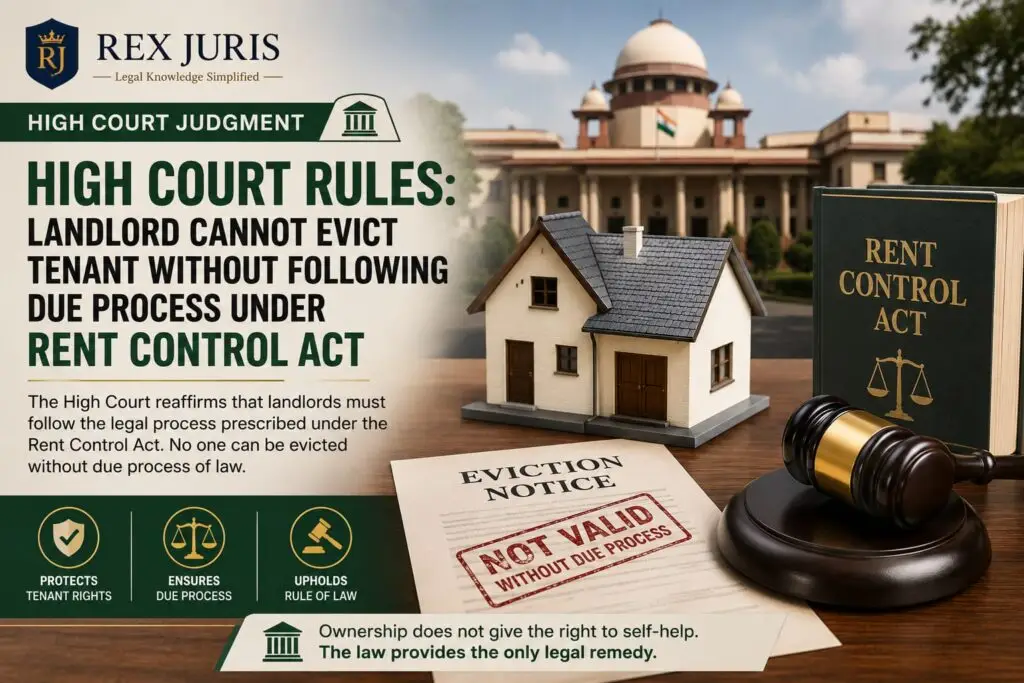
The relationship between a landlord and a tenant is one of the most common yet legally intricate relationships in daily life. While landlords have a legitimate right to reclaim their property, tenants — especially in urban areas — are protected by rent control legislation from arbitrary eviction. A recent High Court judgment has once again drawn a firm line: no landlord can evict a tenant outside the legal process prescribed under the applicable Rent Control Act, regardless of how valid their grievance may be.
Background of the Case
In this case, the petitioner (tenant) had been residing in a rented premises for over fifteen years. The landlord issued a notice terminating the tenancy on grounds of personal necessity and sought to reclaim the premises. When the tenant refused to vacate, the landlord approached the Rent Controller seeking an eviction order.
However, the landlord simultaneously changed the lock on the main gate and disconnected the water supply to the premises — classic examples of ‘self-help eviction’ — even while the eviction proceedings were pending before the Rent Controller. The tenant approached the High Court challenging this action through a writ petition under Article 226 of the Constitution.
What the High Court Held
The High Court allowed the writ petition and passed the following directions:
- The act of the landlord in locking the premises and disconnecting utilities without a valid eviction order was held to be illegal, high-handed, and in gross violation of the tenant’s rights.
- A landlord cannot resort to self-help eviction. The only remedy available to a landlord who wants to evict a tenant is through the procedure prescribed under the Rent Control Act — i.e., filing an eviction petition, getting a hearing, and obtaining an eviction order.
- The court directed the landlord to restore the premises to the tenant immediately and restore all utility connections.
- The court imposed a cost on the landlord for contemptuous and high-handed conduct.
- The court observed that the rent control legislation is a social welfare legislation and must be interpreted to protect the economically weaker party.
Grounds for Eviction Under Rent Control Law
Tenants enjoy statutory protection under various state Rent Control Acts. Eviction is permitted only on specific grounds, such as:
- Default in payment of rent
- Sub-letting without permission
- Using the premises for illegal or immoral purposes
- Causing structural damage to the property
- Landlord’s bona fide need for personal occupation
- The premises becoming unsafe for habitation
Even when a valid ground exists, the landlord must approach the Rent Controller (a designated judicial/quasi-judicial authority) and obtain a decree of eviction before the tenant can be asked to vacate.
What Is Self-Help Eviction?
Self-help eviction refers to a landlord’s attempt to forcibly remove a tenant without following the legal process. Common examples include:
- Changing locks
- Removing doors or windows
- Cutting off electricity, water, or gas
- Threatening or intimidating the tenant
- Removing the tenant’s belongings
In India, self-help eviction is not recognized as a legal remedy and is treated as an illegal act. The tenant can seek relief not only before the Rent Controller but also before the civil court and the High Court under writ jurisdiction.
Rights of Tenants You Must Know
- Right to receive a proper notice before initiation of eviction proceedings.
- Right to contest the eviction petition before the Rent Controller.
- Right to appeal against an eviction order before the Appellate Authority and High Court.
- Right to remain in possession until all legal remedies are exhausted.
- Right to approach the court if subjected to harassment or self-help eviction.
Conclusion
This judgment reaffirms a fundamental principle of tenancy law — that even if a landlord has a legitimate grievance, they cannot take the law into their own hands. The legal process exists for a reason, and bypassing it is not a shortcut but an illegal act with serious consequences. Tenants must be aware of their rights, and landlords must understand that due process is not optional.
About The Author




More Stories
SC: Assessment Committee Not Bound to Average APR/PMS and Work Report Marks for Promotion
Supreme Court Quashes Advocate’s Blacklisting in IBA Caution List: Banks Cannot Punish Lawyers for Alleged Professional Negligence
Supreme Court Restores Widow’s Property Rights: Unexplained Suspicious Circumstances Render Registered Will Invalid