

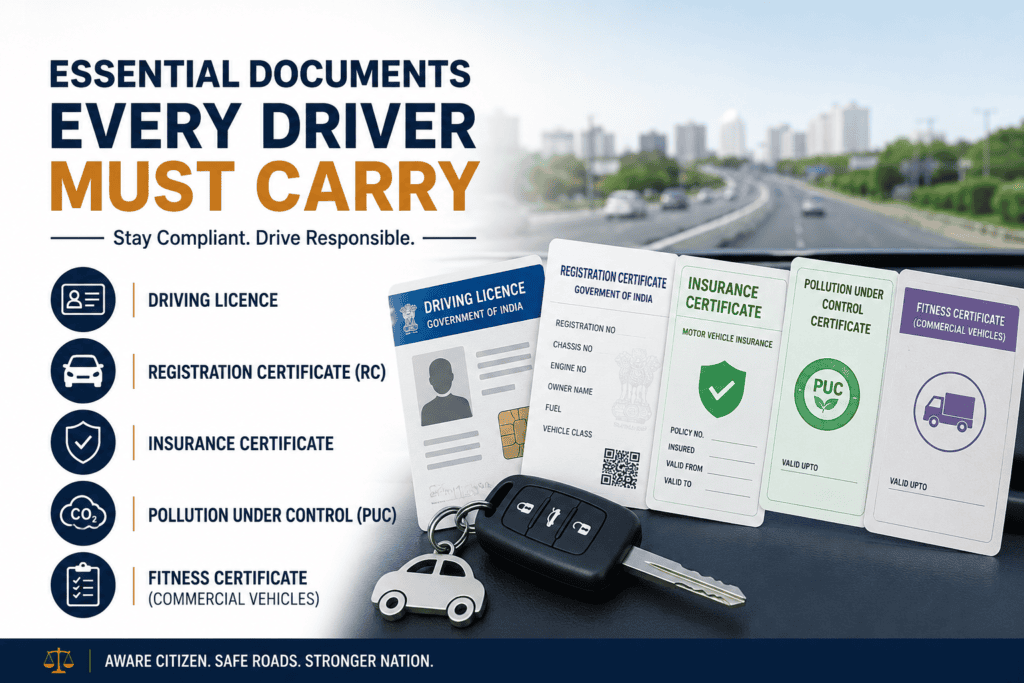
Driving a motor vehicle is not only a convenience but also a legal responsibility. Every person driving on Indian roads must carry certain mandatory documents as prescribed under the Motor Vehicles Act, 1988 and the rules made thereunder. Failure to produce these documents during a traffic inspection may result in fines, prosecution, or other legal consequences.
With the introduction of digital governance, many of these documents can now be carried electronically through government-approved applications such as DigiLocker and mParivahan, making compliance easier than ever.
This article explains the essential documents every driver must carry, why they are important, the legal consequences of not carrying them, and the remedies available to citizens.
1. Driving Licence (DL)
A Driving Licence is the most important legal document required to drive any motor vehicle in India. It is an official authorization issued by the licensing authority permitting a person to operate a particular class of vehicle.
Why is it mandatory?
The licence confirms that the driver has passed the required driving tests and possesses the necessary knowledge of traffic rules and road safety.
Information available on the Driving Licence
- Driver’s Name
- Photograph
- Date of Birth
- Licence Number
- Vehicle Class Authorized
- Date of Issue
- Date of Expiry
- Licensing Authority
Important Points
- Always ensure your licence is valid and not expired.
- Driving with an expired licence may attract legal consequences.
- Learner’s Licence holders must comply with all learner conditions.
- Commercial drivers must possess the appropriate transport vehicle endorsement where required.
2. Registration Certificate (RC)
Every motor vehicle must be registered with the Regional Transport Office (RTO). The Registration Certificate serves as legal proof of ownership.
The RC contains:
- Vehicle Registration Number
- Owner’s Name
- Engine Number
- Chassis Number
- Vehicle Class
- Fuel Type
- Manufacturing Details
- Registration Validity
Why is it important?
The Registration Certificate proves that the vehicle is legally registered and permitted to be driven on public roads.
Whenever ownership changes, the RC should also be transferred to the new owner.
3. Motor Vehicle Insurance Certificate
Motor insurance protects both the vehicle owner and third parties from financial loss arising out of road accidents.
Types of Insurance
Third-Party Insurance
This is mandatory under Indian law.
It covers:
- Death or injury to another person
- Damage to another person’s property
- Legal liabilities arising from accidents
Comprehensive Insurance
In addition to third-party liability, it may also cover:
- Own vehicle damage
- Theft
- Fire
- Natural disasters
- Personal accident benefits (subject to policy terms)
Why should you always carry insurance proof?
Traffic authorities may ask for valid insurance during inspections. Keeping valid proof readily available helps demonstrate compliance with legal requirements.
4. Pollution Under Control (PUC) Certificate
The Pollution Under Control Certificate confirms that your vehicle’s emissions are within the prescribed environmental limits.
Why is it important?
Air pollution caused by motor vehicles is a significant environmental concern. The PUC certificate helps ensure vehicles meet emission standards.
Where can it be obtained?
- Authorized PUC Testing Centres
- Fuel Stations with Pollution Testing Facilities
Validity
The validity depends upon:
- Type of vehicle
- Age of vehicle
- Applicable emission norms
Vehicle owners should renew the certificate before it expires.
5. Fitness Certificate (Commercial Vehicles)
A Fitness Certificate is mandatory for transport and commercial vehicles.
It certifies that the vehicle is mechanically fit and safe for public use.
Vehicles requiring Fitness Certificate
- Buses
- Trucks
- Taxis
- School Buses
- Goods Carriages
- Commercial Passenger Vehicles
Private non-transport vehicles generally do not require a separate fitness certificate during their initial registration period, though they remain subject to applicable fitness and registration renewal requirements under law.
Can You Carry Digital Copies?
Yes.
The Government of India recognizes digital versions of vehicle documents made available through approved platforms such as DigiLocker and mParivahan, subject to applicable legal requirements.
Digital copies of the following documents are generally accepted:
- Driving Licence
- Registration Certificate
- Insurance Certificate
- Pollution Under Control Certificate
Drivers should ensure that the documents are genuine, current, and accessible when requested by an authorized officer.
What Happens If You Fail to Produce These Documents?
During routine traffic checks, authorized officers may ask you to produce the required documents.
Depending on the circumstances and the applicable provisions of law, failure to produce mandatory documents may lead to:
- Monetary penalties
- Issuance of a challan
- Requirement to produce documents within the prescribed procedure, where permitted
- Further legal action in cases involving serious or repeated violations
The consequences may vary based on the specific violation, amendments in force, and applicable state rules.
Practical Tips for Every Driver
- Check the validity of all documents before every long journey.
- Renew documents before they expire.
- Keep original documents in a secure place.
- Maintain digital copies in DigiLocker or mParivahan for convenience.
- Verify that insurance coverage remains active.
- Ensure the PUC certificate is renewed on time.
- If driving a commercial vehicle, monitor the Fitness Certificate’s validity carefully.
- Promptly update records after a change of ownership or address, where required.
Frequently Asked Questions (FAQs)
Can I show a digital Driving Licence?
Yes. Digital documents available through officially recognized government platforms are generally accepted, subject to applicable rules.
Is Third-Party Insurance compulsory?
Yes. A valid third-party motor insurance policy is mandatory for vehicles used on public roads.
Is a PUC Certificate mandatory?
Yes, vehicles that are required to undergo emission testing must maintain a valid Pollution Under Control (PUC) certificate in accordance with applicable regulations.
Is a Fitness Certificate required for private cars?
A separate Fitness Certificate is generally required for transport/commercial vehicles. Private vehicles are governed by the registration and fitness provisions applicable to them under the Motor Vehicles Act and related rules.
Can traffic police ask for these documents?
Yes. Authorized officers may inspect these documents during lawful traffic checks.
Conclusion
Every responsible driver should understand that carrying the required vehicle documents is not merely a legal formality—it contributes to road safety, regulatory compliance, and the protection of your legal rights. Keeping your Driving Licence, Registration Certificate, Insurance Certificate, Pollution Under Control Certificate, and, where applicable, Fitness Certificate valid and readily available can help you avoid unnecessary inconvenience and demonstrate responsible road use.
Disclaimer: This article is intended for educational and legal awareness purposes only and does not constitute legal advice. Readers should refer to the latest provisions of the Motor Vehicles Act, 1988, the Central Motor Vehicles Rules, applicable state rules, and subsequent amendments. For advice on specific legal issues, consult a qualified advocate.
About The Author



More Stories