

Introduction
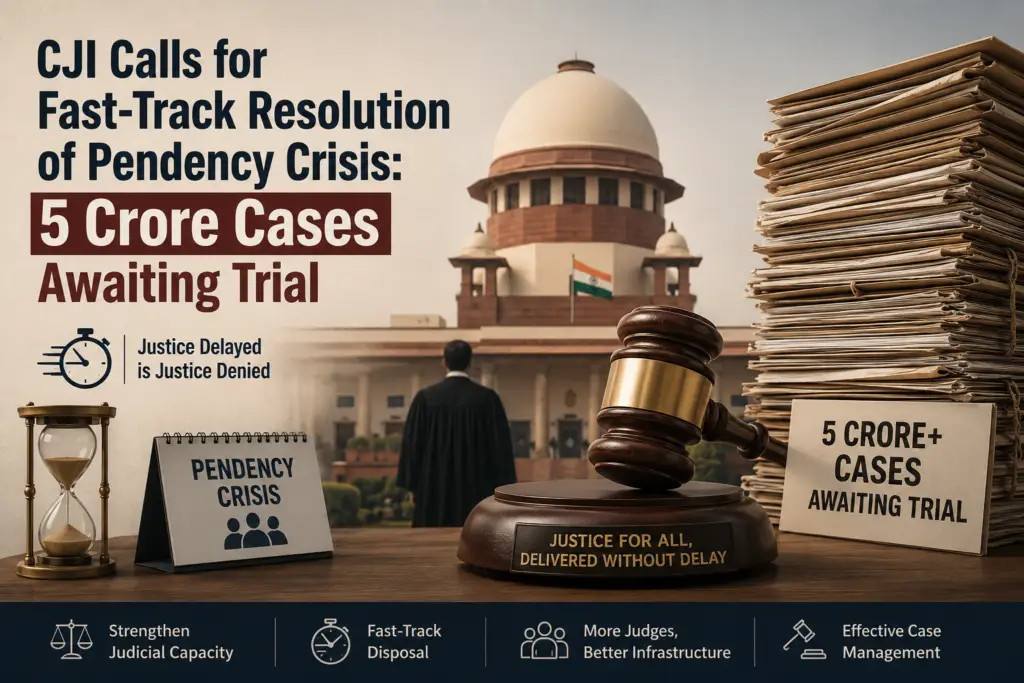
India’s judiciary is grappling with one of the most severe case pendency crises in its history. With over 5 crore (50 million) cases pending across various courts — from the Supreme Court down to subordinate courts — the Chief Justice of India (CJI) has called for urgent, coordinated action to address the backlog and strengthen the delivery of justice.
The Scale of the Problem
According to data from the National Judicial Data Grid (NJDG), as of early 2026:
- Over 80,000 cases are pending before the Supreme Court of India.
- Approximately 60 lakh cases are pending before the 25 High Courts.
- A staggering 4.4 crore cases are pending before District and Subordinate Courts across the country.
- A significant percentage of pending cases are over 10 years old.
The pendency crisis affects not just litigants but also undermines public confidence in the rule of law. It disproportionately impacts the economically weak, who cannot afford prolonged litigation and are often compelled to settle for unjust outcomes.
CJI’s Statements and Proposals
Speaking at a national law conference, the CJI proposed a multi-pronged strategy to address the pendency crisis:
- Filling Judicial Vacancies: India currently has a significant number of judicial vacancies at all levels. The CJI urged the government to expedite the appointment process and fill vacancies urgently.
- Fast-Track Courts: Expansion of Fast-Track Special Courts (FTSCs) — particularly for cases involving crimes against women and children — under the centrally sponsored scheme.
- E-Courts and Digital Infrastructure: Acceleration of the Phase III e-Courts Mission to digitize court records, enable virtual hearings, and reduce procedural delays.
- Alternative Dispute Resolution (ADR): Promoting Lok Adalats, mediation, and arbitration as alternatives to conventional litigation for suitable categories of disputes.
- Case Management Reforms: Introduction of active case management practices including strict adherence to case timelines and limiting adjournments.
Government’s Response
The Law Ministry has indicated its commitment to reducing pendency and has pointed to several measures already in place, including the new Bharatiya Nagarik Suraksha Sanhita (BNSS) 2023, which contains provisions aimed at speeding up trials. The government has also increased the budget for the e-Courts Mission and is working with High Courts to fill vacancies through the Collegium system.
The Way Forward
Experts in the legal field have suggested that meaningful reduction in pendency requires systemic reforms — not just more judges or more courts, but a fundamental rethinking of how cases are managed, prioritized, and resolved. Encouraging parties to explore mediation and settlement, especially in civil and family disputes, could significantly reduce the burden on courts.
Conclusion
The pendency crisis is a complex, multi-dimensional challenge that requires collaboration between the judiciary, the executive, the bar, and civil society. But at its heart is a simple truth — justice delayed is justice denied, and addressing this crisis is not just an administrative imperative but a constitutional obligation.
About The Author




More Stories