

Being stopped by traffic police is a common experience for motorists. Traffic stops are conducted to enforce road safety, verify compliance with traffic laws, and prevent offences. However, many citizens are unaware that while they are required to cooperate with lawful directions, they also enjoy important legal rights.
Knowing your rights helps ensure that interactions with traffic police remain professional, transparent, and within the limits of the law. It also enables citizens to respond calmly and confidently without unnecessarily escalating the situation.
This article explains the rights of citizens during traffic stops, the powers of traffic police, the duties of drivers, and the legal remedies available if those rights are violated.
Why Do Traffic Police Stop Vehicles?
Traffic police may lawfully stop a vehicle for several reasons, including:
- Routine document verification.
- Enforcement of traffic rules.
- Detection of drunken driving.
- Speed limit enforcement.
- Vehicle safety inspections.
- Verification of registration or permits.
- Security checks during public events or emergencies.
- Investigation of traffic offences or road accidents.
Not every traffic stop indicates that you have committed an offence.
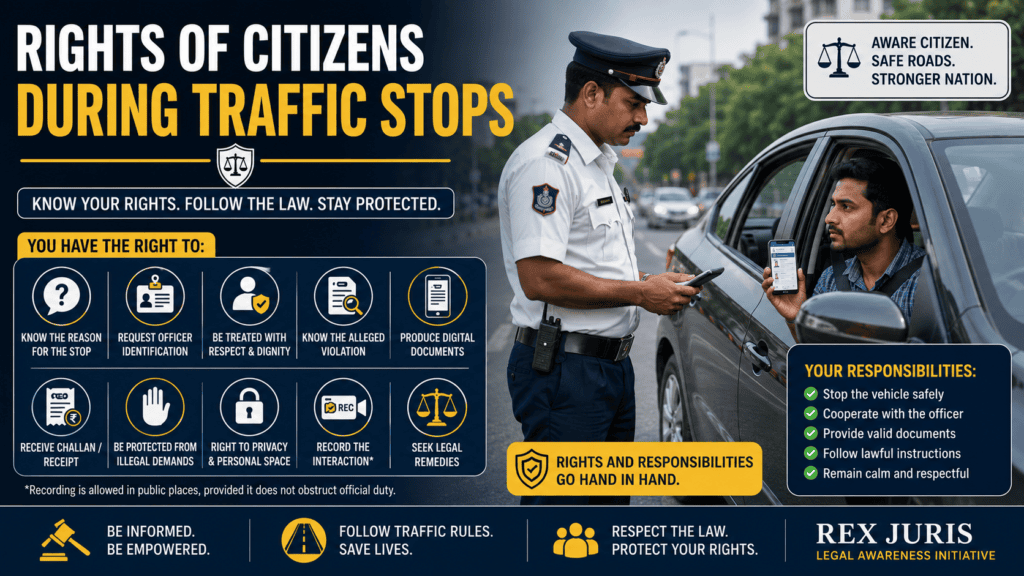
Your Rights During a Traffic Stop
1. Right to Know the Reason for the Stop
You have the right to politely ask why your vehicle has been stopped.
An authorized officer should be able to explain the purpose of the inspection or the alleged traffic violation.
2. Right to Request Identification
If you have genuine doubt about the identity of the officer, you may respectfully request official identification such as:
- Name
- Badge number
- Identification card
- Police station or traffic unit
Police officers performing official duties are generally expected to identify themselves when required.
3. Right to Be Treated with Respect and Dignity
Every citizen has the right to be treated courteously and without discrimination.
Traffic police should not:
- Use abusive language.
- Threaten citizens without lawful authority.
- Humiliate or intimidate motorists.
- Use unnecessary force during a routine traffic inspection.
Professional conduct is expected from both the officer and the citizen.
4. Right to Know the Alleged Violation
If you are accused of violating a traffic rule, you have the right to know:
- The nature of the offence.
- The applicable legal provision, where appropriate.
- The basis for the enforcement action.
Understanding the allegation helps you decide whether to accept the challan or pursue any legal remedies available.
5. Right to Produce Digital Documents
Drivers may generally produce legally recognized digital versions of mandatory documents through government-approved platforms such as DigiLocker or mParivahan.
These may include:
- Driving Licence
- Registration Certificate (RC)
- Insurance Certificate
- Pollution Under Control (PUC) Certificate
6. Right to Receive a Challan or Receipt
Where a fine is imposed or documents are lawfully seized, you have the right to receive the appropriate challan, receipt, or acknowledgement in accordance with the prescribed procedure.
Always verify the details before accepting the document.
7. Right Against Illegal Demands
No citizen is required to pay money outside the legal procedure.
If a penalty is imposed, it should be processed through the prescribed legal mechanism.
Never offer or agree to pay an unofficial amount to avoid legal action.
8. Right to Privacy
A routine traffic stop does not automatically authorize unrestricted access to your personal belongings, mobile phone, or private information.
Any search or inspection beyond what is legally permitted must be supported by lawful authority and applicable legal procedures.
9. Right to Record the Interaction
In many situations, citizens may record their interaction with public officials in a public place, provided that doing so:
- Does not obstruct official duties.
- Does not interfere with an ongoing investigation.
- Does not violate any applicable law or lawful order.
If you choose to record, do so calmly and respectfully.
10. Right to Legal Remedies
If you believe your rights have been violated, you may:
- File a complaint before the senior traffic police authority.
- Approach the police grievance mechanism.
- Challenge an incorrect challan before the competent authority, where permitted.
- Seek legal advice from a qualified advocate.
- Approach the appropriate court where legal rights have been infringed.
Responsibilities of Citizens During Traffic Stops
Rights and responsibilities go hand in hand.
Every driver should:
- Stop the vehicle safely when directed.
- Remain calm and respectful.
- Switch off the engine if instructed.
- Produce required documents.
- Cooperate with lawful directions.
- Avoid arguments or aggressive behaviour.
- Follow traffic police instructions that are lawful and reasonable.
- Obtain official receipts whenever applicable.
What You Should Not Do
During a traffic stop, avoid:
- Arguing aggressively.
- Using abusive language.
- Attempting to flee.
- Offering or accepting a bribe.
- Destroying or concealing evidence.
- Obstructing a public servant in the discharge of official duties.
- Recording in a manner that interferes with official work.
Such actions may lead to additional legal consequences.
If You Receive an Incorrect Challan
If you believe a challan has been issued incorrectly:
- Read the challan carefully.
- Verify the vehicle details and alleged offence.
- Preserve photographs, dashcam footage, GPS data, or other relevant evidence.
- Submit a representation through the prescribed grievance or appeal mechanism, where available.
- Seek legal advice if necessary.
Do not ignore a challan without understanding the legal consequences.
If an Officer Misbehaves
If you experience misconduct:
- Stay calm and avoid confrontation.
- Note the officer’s name, badge number, date, time, and location.
- Collect witness details if available.
- Preserve lawful evidence.
- Submit a written complaint to the appropriate supervisory authority.
- Pursue legal remedies if your rights have been violated.
Frequently Asked Questions (FAQs)
Can traffic police stop my vehicle without a reason?
Traffic police may stop vehicles for lawful purposes such as routine enforcement, document verification, road safety checks, or investigations. You may politely ask the reason for the stop.
Can I refuse to show my documents?
No. Drivers are legally required to produce mandatory documents when lawfully requested by an authorized officer.
Can I pay the fine immediately?
Depending on the nature of the offence and the applicable procedure, fines may be paid through the prescribed online or offline mechanism. Ensure you receive an official receipt.
Can traffic police search my mobile phone?
A routine traffic stop does not ordinarily authorize inspection of your mobile phone or personal data without lawful authority.
What should I do if I feel intimidated?
Remain calm, cooperate with lawful directions, document the incident where legally permissible, and pursue the appropriate complaint or legal remedy after the interaction.
Practical Tips for Every Driver
- Keep all mandatory vehicle documents current.
- Carry digital copies through approved government applications.
- Follow traffic rules at all times.
- Be polite and cooperative.
- Know your legal rights and responsibilities.
- Avoid roadside arguments.
- Keep emergency contact numbers readily available.
- Consult an advocate if you believe your legal rights have been infringed.
Conclusion
Traffic stops are a routine part of road safety enforcement and should not be viewed with fear. While traffic police have important powers under the law, those powers are balanced by the rights guaranteed to every citizen. By understanding your legal rights, complying with lawful directions, and responding calmly, you can ensure that every traffic stop is handled professionally and lawfully. An informed citizen is better equipped to protect both personal rights and public safety.
Disclaimer: This article is intended solely for educational and legal awareness purposes and does not constitute legal advice. The rights and obligations discussed may vary depending on the facts of each case, applicable statutory provisions, judicial decisions, and local rules. Readers should consult a qualified advocate for advice on specific legal issues.
About The Author

More Stories
When Can Your Driving Licence Be Suspended in India?
Can Traffic Police Seize Your Vehicle in India? Know the Law, Your Rights, and Legal Remedies
What Police Can Legally Ask During Vehicle Checking in India? Know Your Rights and Duties