

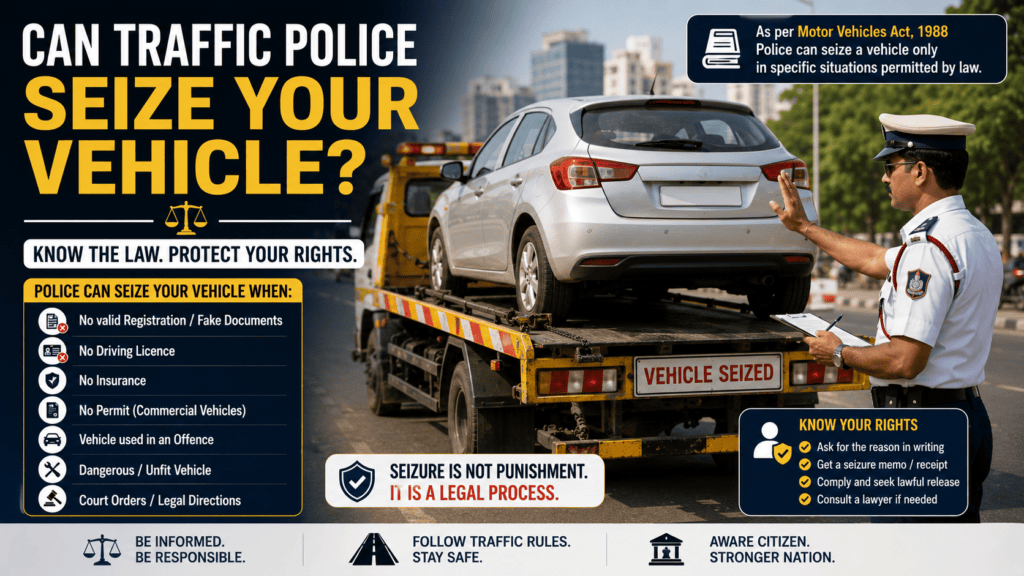
One of the most common questions motorists ask is, “Can traffic police seize my vehicle?” The answer is yes—but only in specific circumstances authorized by law. Traffic police cannot seize a vehicle arbitrarily or without legal justification.
The Motor Vehicles Act, 1988, along with the Central Motor Vehicles Rules and other applicable laws, empowers authorized officers to detain, seize, or impound vehicles in certain situations to enforce road safety and legal compliance. At the same time, citizens have legal rights that protect them from misuse of these powers.
This article explains when traffic police can legally seize your vehicle, when they cannot, the procedure they should follow, and the remedies available if you believe your vehicle has been wrongfully seized.
What Does “Seizure” of a Vehicle Mean?
Vehicle seizure refers to the lawful act of taking possession of a vehicle by an authorized police or transport authority for reasons permitted under the law.
Depending on the circumstances, the vehicle may be:
- Temporarily detained.
- Impounded at a police station or authorized yard.
- Produced before the competent authority or court.
- Released after compliance with legal requirements.
Vehicle seizure does not automatically mean that ownership of the vehicle is lost.
Circumstances Where Traffic Police Can Legally Seize a Vehicle
1. Driving Without a Valid Registration
Every motor vehicle used on public roads must be registered.
If a vehicle is found to be operating without a valid registration or with a fraudulent registration, authorized officers may take action in accordance with the Motor Vehicles Act.
2. Driving Without a Valid Driving Licence
If a person is driving without holding the appropriate and valid driving licence, the officer may initiate legal action. Depending on the facts of the case and the applicable provisions, the vehicle may also be detained or seized.
3. Vehicle Used in the Commission of an Offence
Where a vehicle has been used in connection with a criminal offence—such as theft, illegal transportation, or other offences under applicable law—it may be seized as part of the investigation.
4. Stolen or Suspected Stolen Vehicle
If police reasonably suspect that a vehicle is stolen, has tampered engine or chassis numbers, or is otherwise linked to theft, they may seize it for verification and investigation.
5. Commercial Vehicle Operating Without Required Permit
Commercial vehicles must carry valid permits where required.
Examples include:
- Goods vehicles
- Passenger buses
- Tourist vehicles
- Taxis
- Contract carriage vehicles
Operating without the necessary permit may result in detention or seizure as permitted by law.
6. Dangerous or Mechanically Unfit Vehicle
If a vehicle is found to be in a condition that poses a serious risk to public safety, authorities may prohibit its use and take action in accordance with the applicable legal provisions.
Examples include:
- Severely defective brakes
- Unsafe steering mechanism
- Serious structural damage
- Unsafe commercial vehicles
7. Illegal Vehicle Modifications
Certain unauthorized modifications may attract enforcement action.
Examples include:
- Illegal number plates
- Unauthorized flashing lights
- Sirens reserved for emergency services
- Hazardous structural modifications
- Alterations not permitted under law
8. Vehicle Involved in a Serious Road Accident
Where a vehicle is involved in a fatal or serious accident, police may seize it as evidence for investigation, mechanical inspection, or court proceedings.
9. Court Orders or Government Directions
A competent court or authority may direct the seizure or detention of a vehicle in accordance with law.
Traffic police are required to comply with such lawful orders.
Can Traffic Police Seize a Vehicle for Minor Traffic Violations?
In many routine traffic violations—such as failure to wear a seat belt, helmet violations, or minor documentation issues—the usual course of action is issuance of a challan or other statutory proceedings.
Seizure of a vehicle is generally reserved for situations where the law specifically authorizes such action or where the circumstances justify detention in the interest of public safety or legal enforcement.
Can Police Seize Your Vehicle for Not Carrying Documents?
If you fail to produce mandatory documents, the consequences depend on the nature of the violation and the applicable legal provisions.
Where valid digital documents are available through officially recognized government platforms such as DigiLocker or mParivahan, they are generally accepted in accordance with applicable rules.
Not every documentation issue automatically results in seizure of the vehicle.
What Procedure Should Police Follow?
When a vehicle is lawfully seized, the officer should generally:
- Inform the driver of the reason for seizure.
- Prepare the required legal documentation.
- Maintain proper records of the seized vehicle.
- Issue an acknowledgement or seizure memo where required.
- Keep the vehicle in authorized custody.
The exact procedure may vary depending on the applicable law and the nature of the offence.
Rights of the Vehicle Owner
Every vehicle owner has important legal rights, including:
- To know the legal reason for seizure.
- To receive information about the authority handling the matter.
- To obtain copies of relevant records where legally permissible.
- To seek release of the vehicle in accordance with law.
- To challenge unlawful or arbitrary action before the appropriate authority or court.
How Can You Get Your Vehicle Released?
The process generally depends on the reason for seizure.
It may involve:
- Producing valid documents.
- Paying any applicable penalties where legally required.
- Complying with directions issued by the competent authority.
- Obtaining orders from the court, where necessary.
- Completing any required investigation or verification.
In cases involving criminal proceedings, the release of the vehicle may require orders from the jurisdictional court.
What Should You Do If You Believe the Seizure Was Illegal?
If you believe your vehicle was seized without lawful authority:
- Remain calm and cooperate with the officer.
- Request the legal grounds for the seizure.
- Obtain copies of any seizure memo, receipt, or related documents.
- Note the officer’s name, badge number, date, time, and location.
- Preserve any evidence or witness details.
- Submit a complaint to the senior police or transport authority if appropriate.
- Consult a qualified advocate and seek relief before the competent court if your legal rights have been violated.
Frequently Asked Questions (FAQs)
Can traffic police seize my vehicle for not wearing a helmet?
A helmet violation generally results in statutory enforcement action such as a challan. Whether a vehicle may be detained depends on the specific circumstances and the applicable legal provisions.
Can police seize my vehicle if I forget my Driving Licence at home?
Where legally recognized digital versions are available, they may generally be produced through approved government platforms. The action taken in the absence of proof of a valid licence depends on the applicable law and the facts of the case.
Can traffic police permanently keep my vehicle?
No. Seizure is a legal process subject to statutory provisions. Permanent deprivation of ownership can occur only in accordance with law and, where applicable, orders of a competent authority or court.
Can I challenge a wrongful seizure?
Yes. If you believe the seizure was unlawful, arbitrary, or beyond the powers granted by law, you may seek appropriate legal remedies before the competent authority or court.
Conclusion
Traffic police have the legal authority to seize or detain vehicles only in situations specifically authorized by law. This power exists to promote road safety, prevent unlawful activities, and ensure compliance with the Motor Vehicles Act. At the same time, citizens are entitled to fair treatment, transparency, and due process. Understanding both your obligations and your rights can help you respond appropriately during any enforcement action and protect your legal interests.
Disclaimer: This article is intended for educational and legal awareness purposes only and does not constitute legal advice. The legality of any vehicle seizure depends on the specific facts, applicable provisions of the Motor Vehicles Act, 1988, the Central Motor Vehicles Rules, the Bharatiya Nagarik Suraksha Sanhita (where applicable), and judicial decisions. For advice on a particular matter, consult a qualified advocate.
About The Author




More Stories
When Can Your Driving Licence Be Suspended in India?
Rights of Citizens During Traffic Stops in India: What Every Driver Should Know
What Police Can Legally Ask During Vehicle Checking in India? Know Your Rights and Duties