

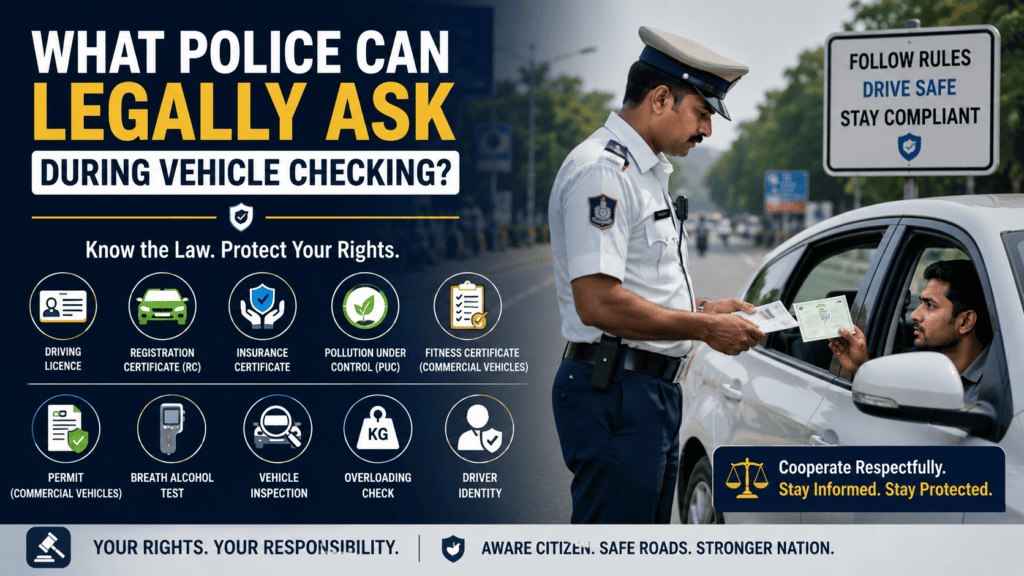
Vehicle checking is a routine exercise conducted by traffic police and other authorized law enforcement officers to ensure compliance with the Motor Vehicles Act, 1988, the Central Motor Vehicles Rules, and other applicable laws. Such inspections help promote road safety, prevent traffic violations, and detect offences.
Many citizens become anxious or uncertain during a traffic stop because they are unaware of their legal rights and obligations. While traffic police have statutory powers to inspect vehicles and verify compliance, those powers are subject to the law. Citizens also have legal protections against arbitrary or unlawful actions.
This article explains what traffic police can legally ask during vehicle checking, what they cannot do without legal authority, and the rights and responsibilities of every driver.
Purpose of Vehicle Checking
Traffic checking may be conducted for several lawful reasons, including:
- Verification of mandatory vehicle documents.
- Detection of drunken driving.
- Enforcement of traffic rules.
- Prevention of vehicle theft.
- Verification of vehicle registration.
- Road safety enforcement.
- Special security checks during public events or emergencies.
Drivers should cooperate with lawful inspections while remaining aware of their legal rights.
What Can Police Legally Ask During Vehicle Checking?
1. Driving Licence (DL)
Traffic police may require the driver to produce a valid Driving Licence to verify that they are legally authorized to drive the vehicle.
The licence may be shown in:
- Physical form
- DigiLocker
- mParivahan
A valid digital licence is generally accepted under applicable government notifications.
2. Registration Certificate (RC)
Police may inspect the Registration Certificate to verify:
- Ownership
- Registration number
- Vehicle details
- Registration validity
The RC may also be produced digitally through approved government applications.
3. Motor Insurance Certificate
The officer may verify whether the vehicle has valid motor insurance.
Every vehicle used on a public road must have at least a valid Third-Party Insurance Policy.
4. Pollution Under Control (PUC) Certificate
Police may ask for the Pollution Under Control Certificate to verify compliance with emission standards.
Driving without a valid PUC certificate may attract penalties under applicable law.
5. Fitness Certificate (Commercial Vehicles)
Commercial vehicles such as buses, taxis, trucks, and goods vehicles may be required to produce a valid Fitness Certificate.
6. Permit (Commercial Vehicles)
Commercial transport vehicles may also be asked to produce:
- Goods Permit
- Passenger Permit
- National Permit
- State Permit
depending on the type of vehicle and its operations.
7. Identity of the Driver
Where necessary, police may ask the driver’s name and basic identification details to verify identity during lawful enforcement.
8. Vehicle Inspection
Police may visually inspect:
- Registration plate
- Chassis details (where legally necessary)
- Vehicle modifications
- Safety equipment
- Number plate compliance
- Reflectors and lights
9. Breath Alcohol Test
If an officer reasonably suspects that a driver has consumed alcohol, they may require the driver to undergo a breath analysis using an approved breath analyzer.
If necessary and in accordance with law, the driver may also be directed for a medical examination.
10. Overloaded Vehicle Inspection
Commercial vehicles may be inspected for:
- Excess passengers
- Overloading
- Unsafe transportation of goods
Can Police Ask You to Unlock Your Mobile Phone?
Generally, during a routine traffic check, traffic police cannot require you to unlock your mobile phone or inspect its personal contents without lawful authority.
If a separate criminal investigation is involved, different legal procedures and powers may apply.
Can Police Search Your Vehicle?
Police may inspect a vehicle where authorized by law, particularly when there is reasonable suspicion of an offence or during lawful enforcement operations.
The scope of such searches depends on the circumstances and applicable legal provisions.
Can Police Seize Your Vehicle?
Yes. In circumstances specifically authorized by law, police may seize or detain a vehicle, such as when:
- The vehicle is involved in an offence.
- The vehicle is stolen.
- There are serious registration violations.
- The vehicle is being operated illegally.
- Orders of a competent authority require seizure.
The power to seize a vehicle is not unlimited and must be exercised in accordance with law.
Can Police Confiscate Your Driving Licence?
In certain situations authorized by law, an officer may seize or impound a driving licence for specified offences and issue an acknowledgement or receipt, following the prescribed procedure.
What Police Cannot Do During Routine Vehicle Checking
Citizens should know that traffic police generally cannot:
- Demand money without issuing the prescribed legal process.
- Misbehave, threaten, or use abusive language.
- Force a confession.
- Retain original documents indefinitely without lawful authority.
- Search personal belongings arbitrarily without legal justification.
- Harass citizens without reasonable cause.
Any misuse of authority may be challenged through the appropriate legal and departmental mechanisms.
Duties of Every Citizen During Vehicle Checking
Every responsible driver should:
- Stop the vehicle safely when directed.
- Remain calm and respectful.
- Produce the required documents.
- Follow lawful instructions.
- Avoid arguments or obstruction.
- Request official identification if there is doubt about the officer’s authority.
- Obtain a receipt whenever documents are lawfully seized or penalties are imposed.
What Should You Do If You Believe the Police Acted Unlawfully?
If you believe that your rights have been violated:
- Stay calm and avoid confrontation.
- Note the officer’s name, badge number, vehicle number, date, time, and location.
- Preserve any lawful evidence, such as photographs or videos where permissible.
- Collect details of any independent witnesses.
- Submit a complaint to the senior traffic police authority or police grievance mechanism.
- Where appropriate, seek legal advice from a qualified advocate and pursue remedies available under law.
Frequently Asked Questions (FAQs)
Can I show my Driving Licence on my mobile phone?
Yes. Digital versions available through officially recognized government platforms such as DigiLocker and mParivahan are generally accepted.
Can police stop any vehicle?
Yes. Authorized officers may stop vehicles for lawful traffic enforcement, document verification, road safety checks, or other legally permitted purposes.
Can I refuse to show my vehicle documents?
Drivers are legally required to produce mandatory documents when lawfully requested by an authorized officer.
Can traffic police take my vehicle keys?
The circumstances in which an officer may take possession of vehicle keys depend on the applicable law and the facts of the situation. Any such action must have lawful justification.
Can I record my interaction with traffic police?
Recording in a public place is not prohibited merely because it involves a traffic stop, provided it does not obstruct official duties or violate any applicable law. However, local circumstances and legal considerations may affect what is permissible.
Conclusion
Traffic checking is an important tool for maintaining road safety and enforcing traffic laws. Understanding what police can legally ask—and what your own rights and responsibilities are—helps ensure that such interactions remain lawful, respectful, and efficient. As a responsible citizen, always carry the required documents, cooperate with authorized officers, and remain informed about your legal rights.
Disclaimer: This article is intended solely for educational and legal awareness purposes and does not constitute legal advice. The powers of police officers and the rights of citizens depend on the facts of each case and the applicable provisions of the Motor Vehicles Act, 1988, the Central Motor Vehicles Rules, the Code of Criminal Procedure, and other relevant laws. For advice on a specific legal issue, consult a qualified advocate.
About The Author

More Stories
When Can Your Driving Licence Be Suspended in India?
Rights of Citizens During Traffic Stops in India: What Every Driver Should Know
Can Traffic Police Seize Your Vehicle in India? Know the Law, Your Rights, and Legal Remedies