

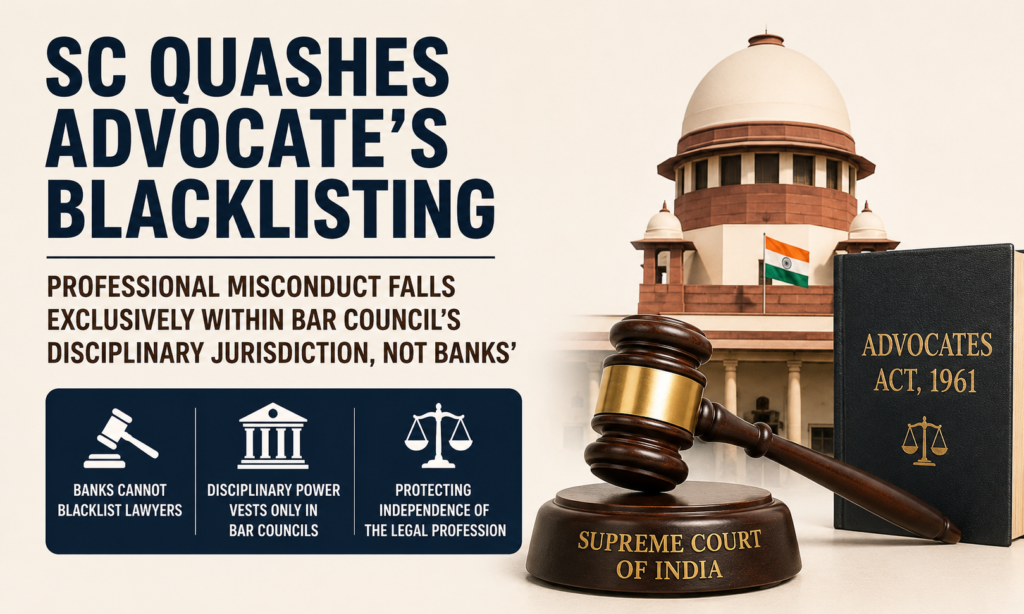
In a landmark judgment strengthening the independence of the legal profession, the Supreme Court has held that banks and the Indian Banks’ Association (IBA) have no authority to virtually blacklist advocates by placing their names in the IBA Caution List merely on allegations of professional negligence.
The Court ruled that questions relating to an advocate’s professional competence, negligence or misconduct fall exclusively within the disciplinary jurisdiction of the Bar Councils under the Advocates Act, 1961.
The judgment also contains significant observations on:
- professional independence of advocates,
- self-regulation of the legal profession,
- accountability of the Bar Council of India,
- Continuing Legal Education (CLE), and
- establishment of a National Legal Academy for lawyers.
This decision is expected to become one of the most significant precedents on the autonomy of the legal profession.
Background of the Case
The appellant, Ajay Vijh, had been serving as a panel advocate for Canara Bank.
In 2015, he rendered a legal opinion concerning immovable property offered as collateral security for a loan of ₹2 crore.
Several years later, the bank alleged that:
- a portion of the property had already been sold;
- the legal opinion failed to detect those transactions;
- the omission exposed the bank to financial risk.
Although the advocate explained that his opinion was based on official search records and prevailing professional standards, the bank:
- removed him from its panel; and
- forwarded his name to the Indian Banks’ Association (IBA).
Consequently, his name was included in the IBA Caution List titled “Third Party Entities Involved in Fraud.”
The remark against his name stated:
“Given Wrong Legal Opinion And Negligence in Conducting Search and Bank Was Exposed to Loss and Financial Risk.”
The advocate challenged the action before the Allahabad High Court.
The High Court dismissed the petition on the ground that IBA was not “State” under Article 12.
The matter reached the Supreme Court.
Issues Before the Supreme Court
The Court examined several important constitutional and professional questions:
- Whether a writ petition under Article 226 was maintainable against the IBA.
- Whether banks can place advocates in the IBA Caution List for alleged negligence.
- Whether allegations of professional negligence can be adjudicated by banks.
- Whether only the Bar Councils possess disciplinary jurisdiction over advocates.
Supreme Court’s Findings
1. Writ Petition Under Article 226 Was Maintainable
The Supreme Court disagreed with the Allahabad High Court.
The Court observed that the issue was not merely contractual.
The inclusion of an advocate’s name in the IBA Caution List affects:
- professional reputation,
- future employment opportunities,
- livelihood,
- and the fundamental right to practise law under Article 19(1)(g).
Therefore, judicial review under Article 226 was clearly maintainable.
The Court reiterated that writ jurisdiction depends not merely upon whether an institution is “State”, but also upon the nature of the public function performed.
2. Banks May Remove Panel Advocates—but Cannot Blacklist Them
The Court made an important distinction.
A bank certainly has the contractual freedom to:
- discontinue an advocate’s services,
- remove him from its panel,
- decline future empanelment.
However, the bank cannot issue an industry-wide declaration questioning an advocate’s competence by circulating his name to all banks through the IBA Caution List.
The Court held that such action effectively amounts to professional blacklisting.
3. RBI Caution List Is Meant Only for Fraud—not Mere Negligence
The Court carefully analysed:
- RBI Circular dated 16 March 2009;
- RBI Fraud Classification Directions, 2016;
- RBI Master Directions on Fraud Risk Management, 2024.
The Supreme Court found that the entire regulatory framework was designed to deal with:
- fraud,
- collusion,
- dishonest conduct,
- deliberate facilitation of fraudulent transactions.
It was never intended to punish advocates for professional negligence or errors of judgment.
4. Negligence Cannot Be Treated as Fraud
Perhaps the most significant legal principle emerging from the judgment is that:
Professional negligence is fundamentally different from fraud.
The Court observed:
Fraud necessarily involves:
- dishonest intention,
- deliberate deception,
- mens rea.
A mistaken legal opinion or omission during title verification, without dishonest intention, cannot automatically become fraud.
Therefore, inclusion of the advocate’s name in a fraud-related caution list was completely unsustainable.
5. Professional Misconduct Is the Exclusive Domain of the Bar Councils
The Supreme Court strongly reaffirmed the statutory framework created under the Advocates Act.
The Court held that:
Questions concerning:
- professional negligence,
- professional misconduct,
- competence,
- ethics,
are matters exclusively entrusted to:
- State Bar Councils,
- Bar Council of India.
Banks possess no adjudicatory authority to determine whether an advocate is professionally negligent.
6. Independence of the Bar Requires Self-Regulation
The judgment contains an extensive discussion on the constitutional importance of an independent Bar.
The Court observed:
The legal profession is sui generis.
Unlike other professions, advocates:
- are officers of the court,
- participate in administration of justice,
- owe duties not only to clients but also to courts.
Accordingly, Parliament intentionally created a system where:
Peers regulate peers.
Professional discipline must therefore remain within the Bar Council framework.
Allowing banks to independently pronounce upon professional competence would undermine the independence of the legal profession.
7. Banks Must Approach the Bar Council
The Court clarified that if a bank genuinely believes an advocate has committed professional misconduct, the proper course is:
- file material before the appropriate State Bar Council;
- allow disciplinary proceedings under Sections 35 and related provisions of the Advocates Act.
Banks cannot bypass this statutory mechanism by effectively blacklisting advocates through administrative circulars.
8. Major Directions to the Bar Council of India
The judgment goes far beyond the dispute itself.
The Supreme Court directed the Bar Council of India to:
Conduct Performance Audit
The Court directed BCI to undertake a comprehensive performance audit of its disciplinary system.
The audit should evaluate:
- pendency,
- disposal rates,
- procedural efficiency,
- transparency,
- staffing,
- regional disparities,
- statutory compliance.
Institutionalise Continuing Legal Education (CLE)
The Court observed that India lacks structured post-enrolment legal education.
Accordingly, it directed the BCI to institutionalise:
- Continuing Legal Education (CLE),
- professional ethics training,
- technological competence,
- advocacy skills,
- specialised legal learning.
Consider Establishment of National Legal Academy (NLA)
Drawing inspiration from the National Judicial Academy, the Supreme Court suggested creation of a:
National Legal Academy (NLA)
to provide continuous professional education for advocates throughout their careers.
Final Decision
The Supreme Court:
- Allowed the appeal.
- Set aside the Allahabad High Court judgment.
- Declared inclusion of the advocate’s name in the IBA Caution List illegal.
- Directed immediate removal of his name.
- Directed the Bar Council of India to undertake disciplinary performance audit.
- Directed BCI to consider institutionalising Continuing Legal Education and the National Legal Academy.
Key Legal Principles Established
This landmark judgment establishes that:
- Banks may de-empanel advocates but cannot blacklist them.
- RBI Caution Lists are intended only for fraud-related cases.
- Professional negligence cannot automatically be equated with fraud.
- Only the Bar Councils possess disciplinary jurisdiction over advocates.
- Self-regulation is an essential feature of the independence of the Bar.
- Writ petitions under Article 226 are maintainable where professional reputation and constitutional rights are affected.
- Continuing Legal Education is necessary to maintain professional competence.
- The Bar Council of India must strengthen accountability through institutional reforms.
Why This Judgment Matters
This judgment is likely to have far-reaching consequences for:
- Advocates across India,
- Public Sector Banks,
- Private Banks,
- Financial Institutions,
- Bar Councils,
- Professional Regulatory Bodies.
The decision reinforces an important constitutional principle:
Professional discipline of advocates cannot be outsourced to executive bodies or private associations.
At the same time, the Supreme Court balanced professional independence with accountability by directing systemic reforms within the Bar Council framework.
The judgment is therefore not merely about one advocate—it is a significant reaffirmation of the autonomy, dignity, and accountability of the legal profession in India.
Key Takeaways
✔ Banks may remove advocates from their own panels but cannot blacklist them across the banking sector.
✔ RBI’s Caution List mechanism applies to fraud, not ordinary professional negligence.
✔ Professional misconduct of advocates can be adjudicated only by the Bar Councils under the Advocates Act, 1961.
✔ Writ jurisdiction under Article 226 extends to actions affecting constitutional and professional rights, even against bodies performing public functions.
✔ The Supreme Court has called for Continuing Legal Education (CLE), a performance audit of Bar Council disciplinary mechanisms, and consideration of a National Legal Academy.
Case Details
Case: Ajay Vijh v. Indian Banks Association & Others
Citation: 2026 INSC 670 | Civil Appeal (Arising out of SLP(C) @ Diary No. 10787 of 2024)
Court: Supreme Court of India – Civil Appellate Jurisdiction
Date of Judgment: 7 July 2026
Bench: Justice Pamidighantam Sri Narasimha & Justice Alok Aradhe
Statutes Involved
- Constitution of India – Articles 19(1)(g) & 226
- Advocates Act, 1961 – Sections 35, 36, 36B, 37 & 38
- Banking Regulation Act, 1949 – Section 35A
- RBI Circular dated 16 March 2009
- RBI Master Directions on Fraud Risk Management, 2024
Disclaimer: This article is intended solely for legal awareness and educational purposes. It summarizes and analyzes the Supreme Court’s judgment in Ajay Vijh v. Indian Banks Association & Ors., 2026 INSC 670 (Judgment dated 7 July 2026). It does not constitute legal advice. Readers should consult the full judgment and seek professional legal advice for specific matters.
About The Author

More Stories
SC: Assessment Committee Not Bound to Average APR/PMS and Work Report Marks for Promotion
Supreme Court Restores Widow’s Property Rights: Unexplained Suspicious Circumstances Render Registered Will Invalid
Default Bail Under BNSS: Non-Supply of Chargesheet Copies Does Not Confer Statutory Bail