

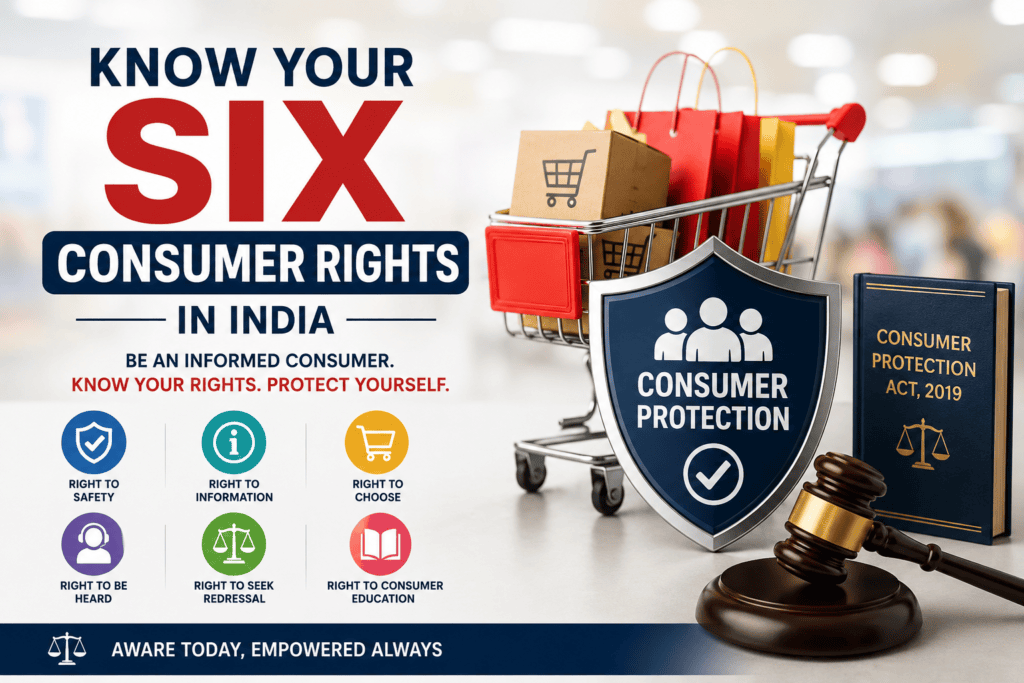
Every day, millions of people purchase products, book services, order food online, pay utility bills, visit hospitals, buy insurance, or shop through e-commerce platforms. Yet many consumers are unaware that Indian law provides strong legal protection against unfair trade practices, defective products, misleading advertisements, and poor services.
The Consumer Protection Act, 2019 recognizes six fundamental consumer rights that empower every consumer to make informed choices and seek legal remedies when their rights are violated.
Understanding these rights can help you avoid fraud, recover compensation, and hold businesses accountable.
Who is a Consumer?
Under the Consumer Protection Act, 2019, a consumer is a person who buys goods or hires or avails services for consideration (payment), whether paid fully, partly, or promised to be paid.
This includes people who:
- Purchase products from shops or online marketplaces
- Use banking or insurance services
- Visit hospitals for paid treatment
- Enroll in coaching institutes (subject to legal interpretation in specific cases)
- Book travel or hotel services
- Purchase electronic goods
- Hire repair or maintenance services
However, purchases made for commercial resale or commercial profit are generally not covered, subject to the exceptions provided in law.
The Six Consumer Rights Under Indian Law
1. Right to Safety
What does it mean?
Consumers have the right to be protected against goods and services that are hazardous to life, health, or property.
Manufacturers and sellers must ensure that their products meet prescribed safety standards before being sold.
Examples
- Defective electrical appliances causing electric shock
- Expired medicines sold by pharmacies
- Faulty LPG cylinders
- Unsafe toys for children
- Poor quality helmets
- Adulterated food products
What should consumers do?
- Purchase products bearing required safety certifications where applicable.
- Read user manuals and warning labels.
- Keep invoices and warranty cards.
- Report dangerous products to the appropriate authorities.
2. Right to Information
What does it mean?
Every consumer has the right to receive complete, accurate, and truthful information before purchasing goods or services.
Businesses must not conceal important facts.
Consumers should be informed about:
- Price
- Quantity
- Quality
- Ingredients
- Manufacturing date
- Expiry date
- Warranty
- Terms and conditions
- Risks associated with the product
Example
A food package must clearly mention:
- Net weight
- MRP
- Ingredients
- Nutritional information
- Manufacturing date
- Expiry date
Similarly, electronic products should disclose warranty terms and technical specifications.
3. Right to Choose
Consumers have the freedom to choose goods and services at competitive prices without being forced to purchase unwanted products.
No seller should compel a buyer to purchase another product as a condition for buying the desired product.
Examples
❌ A dealer insists that a customer purchase accessories to buy a vehicle.
❌ A school requires parents to buy uniforms only from a specified vendor without lawful justification.
Consumers are entitled to make independent purchasing decisions.
4. Right to Be Heard
Consumers have the right to have their complaints considered fairly by businesses and consumer authorities.
Businesses should provide accessible mechanisms for handling grievances.
If a complaint is ignored, consumers may approach the appropriate Consumer Commission.
Typical complaints include
- Defective goods
- Poor services
- Overcharging
- Wrong billing
- Misleading advertisements
- Delay in delivery
- Refusal to honor warranty
5. Right to Seek Redressal
If a consumer suffers loss due to defective goods, deficient services, unfair trade practices, or misleading advertisements, they have the right to seek legal remedies.
Depending on the facts of the case, the Consumer Commission may grant appropriate relief, such as:
- Replacement of defective goods
- Repair of the product
- Refund of the price paid
- Compensation for loss or injury
- Removal of defects
- Discontinuance of unfair trade practices
- Corrective advertisements in appropriate cases
- Other relief as permitted by law
Each case is decided on its own facts and applicable legal provisions.
6. Right to Consumer Education
Consumers have the right to receive education regarding their legal rights and responsibilities.
Awareness helps consumers:
- Avoid scams
- Understand warranties
- Detect fake products
- Identify misleading advertisements
- File complaints properly
- Preserve important evidence
An informed consumer is less likely to become a victim of unfair business practices.
Responsibilities of Consumers
Consumer rights are accompanied by certain responsibilities.
Every consumer should:
- Always ask for a proper bill or invoice.
- Read product labels carefully.
- Check the MRP before payment.
- Verify manufacturing and expiry dates.
- Read warranty and guarantee terms.
- Keep purchase records safely.
- Use products according to instructions.
- Report defective or unsafe goods promptly.
- Avoid purchasing counterfeit products.
- Make complaints with accurate facts and supporting documents.
Practical Example
Imagine you purchase a refrigerator that stops working within a week.
You immediately contact the seller, but the seller refuses to repair or replace it despite the warranty.
In this situation, your rights may include:
- Right to Safety (if the defect creates a safety risk)
- Right to Information (if material facts or warranty terms were misrepresented)
- Right to Be Heard (to have your grievance considered)
- Right to Seek Redressal (to pursue appropriate legal remedies if the dispute is not resolved)
Keeping the invoice, warranty card, photographs or videos of the defect, and copies of communications with the seller can strengthen your claim.
How to Protect Yourself as a Consumer
Before making a purchase:
- Compare products and prices.
- Buy from reliable sellers.
- Read online reviews critically.
- Verify warranty terms.
- Request a GST invoice where applicable.
- Check return and refund policies.
- Preserve digital receipts and screenshots for online purchases.
After purchase:
- Inspect the product immediately.
- Report defects without unnecessary delay.
- Communicate complaints in writing where possible.
- Keep all records until the issue is resolved.
Frequently Asked Questions (FAQs)
Can I file a consumer complaint without a lawyer?
Yes. Consumers may file complaints themselves before the appropriate Consumer Commission. However, legal advice may be beneficial in complex matters.
Is an online buyer also a consumer?
Yes. Consumers purchasing goods or services through e-commerce platforms generally enjoy the same protections under the Consumer Protection Act, 2019.
Can I seek compensation for mental harassment?
Consumer Commissions may award compensation, including for mental agony or inconvenience, where justified by the facts and law.
What if I lose my purchase bill?
Other evidence—such as bank statements, digital payment records, emails, SMS messages, warranty registrations, or order confirmations—may help establish the transaction, depending on the circumstances.
Conclusion
Consumer rights are not merely legal provisions—they are practical protections available to every citizen. By understanding your Right to Safety, Information, Choice, Be Heard, Redressal, and Consumer Education, you can make informed decisions and respond effectively when faced with defective products, deficient services, or unfair trade practices.
Knowing your rights, preserving purchase records, and acting promptly can make a significant difference in resolving consumer disputes.
Disclaimer
This article is intended solely for general legal awareness and educational purposes. It does not constitute legal advice or create an advocate–client relationship. Consumer disputes depend on the specific facts of each case. Readers should consult a qualified advocate for advice tailored to their individual circumstances.
About The Author

More Stories
When are You NOT Considered a Consumer?
Who is a Consumer under the Consumer Protection Act, 2019?