

Introduction
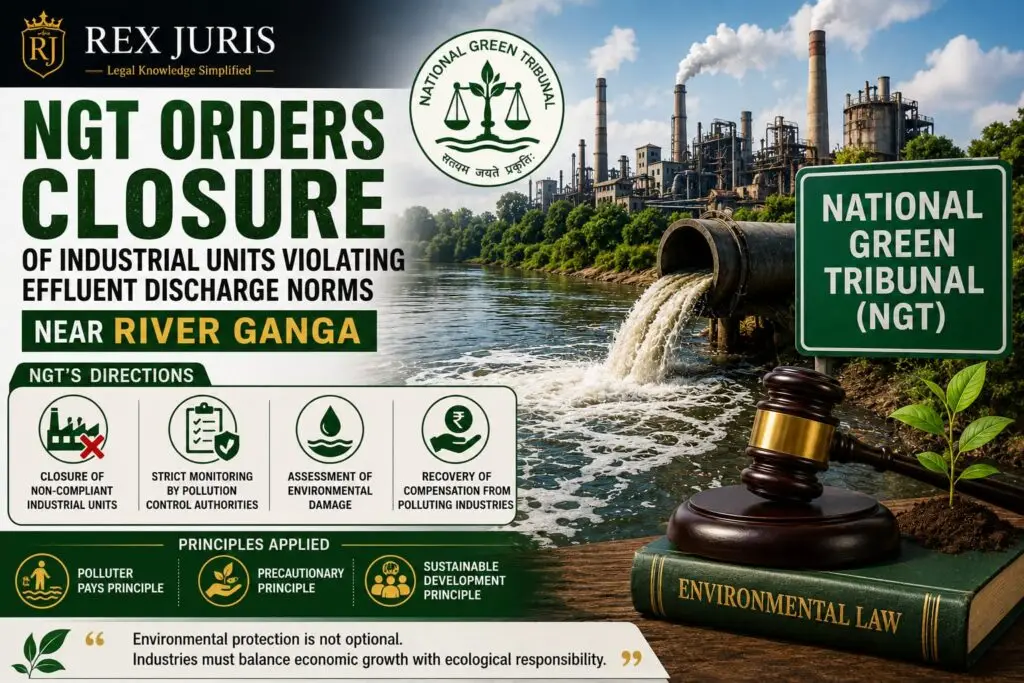
The National Green Tribunal (NGT), established under the National Green Tribunal Act, 2010, has consistently emerged as one of India’s most proactive environmental adjudicatory bodies. In a landmark order, the NGT directed the immediate closure of several industrial units located in proximity to the River Ganga that were found to be illegally discharging untreated effluents into the river, in flagrant violation of the Environment Protection Act, 1986 and the Water (Prevention and Control of Pollution) Act, 1974.
Background
The matter was initiated on the basis of a complaint filed before the NGT by an environmental activist and a local NGO, alleging that multiple tanneries and chemical processing units in the Ganga belt were releasing toxic effluents directly into the river or its tributaries without proper treatment. These effluents contained heavy metals like chromium and arsenic, which were causing severe environmental degradation and posing a health hazard to communities living along the riverbanks.
The NGT directed the Central Pollution Control Board (CPCB) and the State Pollution Control Board to conduct surprise inspections and submit reports on compliance with effluent discharge standards.
Key Findings of the Tribunal
Based on the inspection reports and evidence placed before it, the NGT found the following:
- Over 40 industrial units were found to be operating without valid Consent to Operate (CTO) certificates issued by the State Pollution Control Board.
- Effluent Treatment Plants (ETPs) in many units were either non-functional or had capacities far below what was required.
- Biochemical Oxygen Demand (BOD) and Chemical Oxygen Demand (COD) levels in the discharged water far exceeded permissible limits.
- Despite prior warnings and show-cause notices, no remedial action had been taken by the defaulting units.
NGT’s Order
The Tribunal issued the following directions:
- Immediate closure of all non-compliant industrial units until they install functional ETPs and obtain fresh Consent to Operate certificates.
- The State Pollution Control Board was directed to file a compliance report within 30 days.
- The defaulting industries were made jointly and severally liable to pay environmental compensation to be deposited in the CPCB’s Environment Protection Fund.
- A joint committee comprising representatives of CPCB, State PCB, and an independent environmental expert was constituted to monitor restoration of the river stretch.
- The District Magistrate of the concerned district was directed to ensure that no closed unit reopens without a clearance certificate from the Pollution Control Board.
Legal Framework
The order draws on a robust legal framework:
- The Polluter Pays Principle — recognized by the Supreme Court in Indian Council for Enviro-Legal Action v. Union of India (1996) — holds that those who cause environmental pollution must bear the cost of restoration.
- Section 5 of the Environment Protection Act empowers authorities to close or regulate industries causing environmental damage.
- The NGT Act, 2010 gives the Tribunal wide powers to pass orders for environmental protection and restoration.
Significance
This order is significant because it demonstrates that India’s environmental tribunals are willing to take strong action against industrial polluters even where economic interests are at stake. The NGT’s intervention in the Ganga pollution issue complements the National Mission for Clean Ganga (NMCG) and sends a clear message that compliance with environmental laws is non-negotiable.
Conclusion
Environmental justice and industrial development need not be at odds. This order of the NGT serves as a reminder that sustainable development — development that does not compromise the ecological resources of future generations — is not just a policy goal but a legally enforceable right under Indian law.
About The Author





More Stories