

Introduction
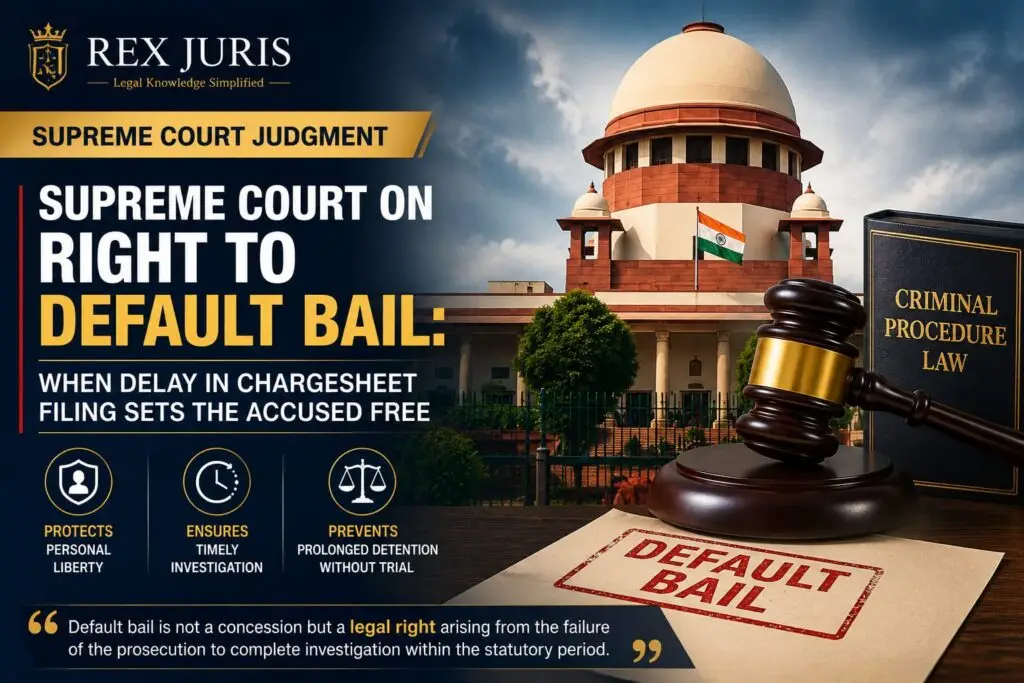
In India’s criminal justice system, personal liberty is considered the most sacred of all fundamental rights. The Constitution of India under Article 21 guarantees every person the right to life and personal liberty, and no person can be deprived of this right except according to procedure established by law. One of the most significant protections built into the criminal law framework is the right to default bail — a statutory right that arises when the investigating agency fails to complete its investigation and file a chargesheet within the prescribed time limit.
Recently, the Supreme Court of India reiterated this long-standing principle and clarified that the right to default bail under Section 167(2) of the Code of Criminal Procedure (CrPC), now mirrored under Section 187 of the Bharatiya Nagarik Suraksha Sanhita (BNSS) 2023, is not a matter of discretion but an indefeasible right that accrues in favour of the accused the moment the time limit expires without a chargesheet being filed.
What is Default Bail?
Default bail, also known as statutory bail or compulsive bail, is a right available to an accused person when the police or investigating agency fails to submit a chargesheet (charge sheet) within the time mandated by law after the accused has been arrested and is in custody.
Under the old CrPC, the time limits were:
- 90 days — for offences punishable with death, life imprisonment, or imprisonment for a term of not less than 10 years.
- 60 days — for all other offences.
Under the new BNSS 2023, these periods remain substantially the same. If the chargesheet is not filed within these periods, the accused becomes entitled to be released on bail upon making an application, provided he is ready to furnish bail. Crucially, the right is not dependent on the merits of the case — it is purely procedural and mandatory in nature.
Background of the Recent Supreme Court Ruling
In the case in question, the accused was arrested in connection with a serious criminal offence and was held in judicial custody. The police sought multiple extensions from the Magistrate to complete the investigation. However, on the expiry of the statutory 90-day period, the accused applied for default bail claiming that no chargesheet had been filed against him.
The Sessions Court rejected this application on the ground that the police had filed an ‘incomplete’ chargesheet before the deadline to forestall the default bail. The High Court upheld the Sessions Court order. The matter was then taken up before the Supreme Court.
What Did the Supreme Court Hold?
The Supreme Court, relying on a series of its own precedents including Rakesh Kumar Paul v. State of Assam (2017) and Sanjay Dutt v. State through CBI (1994), laid down the following important principles:
- The right to default bail is an indefeasible right and vests in the accused as soon as the stipulated period expires without the chargesheet being filed.
- Filing an incomplete chargesheet — one that does not contain the essential ingredients such as witness statements, material evidence, and final report — cannot be treated as a valid chargesheet to defeat the right to default bail.
- The Magistrate must apply his mind to examine whether the document filed by the prosecution is a complete chargesheet in substance and not merely in form.
- If a complete chargesheet is not filed within the prescribed period and the accused applies for default bail and expresses his willingness to furnish bail, the Magistrate has no option but to release him on bail.
- The right to default bail cannot be waived by the accused, and any attempt by the State to circumvent it by filing an incomplete or sham chargesheet is impermissible.
Distinction Between Regular Bail and Default Bail
It is important to understand that default bail is fundamentally different from regular bail under Section 437 or 439 CrPC:
- Regular bail is discretionary and courts examine factors like nature of offence, flight risk, likelihood of tampering with evidence, and criminal antecedents.
- Default bail is a statutory right — it arises automatically on the expiry of the time limit and is not subject to judicial discretion once the right vests.
- However, once the accused is released on default bail, the prosecution may still oppose bail on merits after the chargesheet is filed and seek cancellation if valid grounds exist.
Significance of the Judgment
This ruling is significant for several reasons:
- It reinforces Article 21 and sends a strong message that personal liberty cannot be held hostage to investigative delays.
- It prevents the common practice of filing ‘dummy chargesheets’ or incomplete reports just to defeat the default bail right.
- It empowers Magistrates to scrutinize the completeness of chargesheets rather than mechanically accepting them.
- It provides clarity to defense lawyers and trial courts across the country on how to handle default bail applications.
Practical Implications for Lawyers and Accused
For practicing advocates and law students, this judgment underscores several practical points:
- Always track the date of arrest and compute the 60/90-day period carefully.
- File the default bail application as soon as the period lapses — even a single day’s delay can be crucial.
- Be prepared to argue that the chargesheet filed is incomplete if the prosecution attempts to forestall default bail.
- Courts may require an affidavit from the accused expressing willingness to provide surety/bail.
Conclusion
The Supreme Court’s reaffirmation of the right to default bail is a powerful reminder that procedural safeguards are not mere technicalities — they are the bulwarks of individual liberty. In a country where undertrial prisoners constitute a large portion of the prison population, default bail is one of the most critical tools to ensure that innocent people are not imprisoned indefinitely because of administrative failures. Legal professionals, law students, and citizens must be aware of this right and vigilantly assert it whenever warranted. Rex Juris will continue to monitor and report on important Supreme Court judgments affecting the rights of citizens and the development of criminal law in India
About The Author



More Stories
SC: Assessment Committee Not Bound to Average APR/PMS and Work Report Marks for Promotion
Supreme Court Quashes Advocate’s Blacklisting in IBA Caution List: Banks Cannot Punish Lawyers for Alleged Professional Negligence
Supreme Court Restores Widow’s Property Rights: Unexplained Suspicious Circumstances Render Registered Will Invalid