
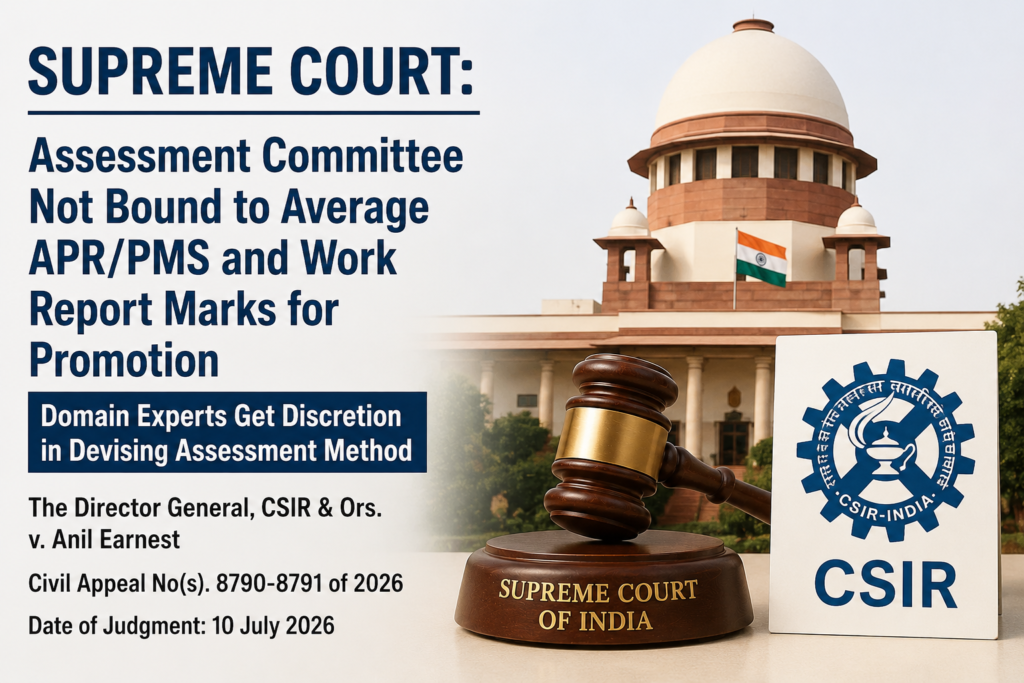
In an important judgment concerning service jurisprudence and promotion assessment, the Supreme Court has clarified that an Assessment Committee constituted under the CSIR Scientists Recruitment & Promotion Rules is not legally required to average Annual Performance Reports (APR/PMS) marks with Work Report marks while determining an employee’s suitability for promotion.
The Court held that Paragraph 3(b) of the CSIR Circular dated 1 June 2011 merely requires the Assessment Committee to consider both APR/PMS and the Work Report. It does not prescribe any mathematical formula or averaging mechanism.
The judgment reinforces the principle that courts should not read words into service rules that are absent, particularly where assessment is entrusted to domain experts.
Background of the Case
The respondent, Dr. Anil Earnest, was serving as a Scientist under the Council of Scientific and Industrial Research (CSIR).
He claimed that he became eligible for promotion to the post of Senior Scientist with effect from 19 September 2012/2013 after securing exceptionally high APR/PMS scores during the relevant residency period.
His APR/PMS scores were:
| Assessment Year | Marks | Grading |
|---|---|---|
| 2009–10 | 90.5 | Outstanding |
| 2010–11 | 95.0 | Outstanding |
| 2011–12 | 94.0 | Outstanding |
| 2012–13 | 89.0 | Excellent |
The average APR/PMS score exceeded 92%, comfortably crossing the 85% eligibility threshold prescribed under Rule 7.4.
However, after evaluating his Work Report, the Assessment Committee awarded him 82%, which was below the promotion benchmark of 85%, and declared him “Not Yet Fit for Promotion.”
Proceedings Before CAT and High Court
The Central Administrative Tribunal accepted the scientist’s contention that the Assessment Committee ought to have averaged the APR/PMS score (92%) with the Work Report score (82%), resulting in an overall score exceeding 85%.
The Tribunal consequently directed that he be promoted retrospectively.
The Karnataka High Court substantially agreed with the Tribunal’s interpretation but modified the relief by directing a review promotion exercise instead of granting direct promotion.
CSIR challenged both decisions before the Supreme Court.
Issues Before the Supreme Court
The Supreme Court considered the following questions:
- Whether Paragraph 3(b) of the CSIR Circular dated 01.06.2011 requires averaging APR/PMS marks with Work Report marks.
- Whether the Assessment Committee has discretion to devise its own assessment methodology.
- Whether courts can prescribe an evaluation formula not contained in the Rules.
Supreme Court’s Analysis
1. Promotion Process Under CSIR Is a Two-Stage Mechanism
The Court explained that the CSIR Rules establish a two-tier promotion process.
First Stage – Internal Screening Committee
The Internal Screening Committee screens candidates solely on the basis of APR/PMS scores and verifies whether they satisfy:
- the minimum residency period; and
- the prescribed performance threshold under Rule 7.4.
Only eligible candidates proceed to the second stage.
Second Stage – Assessment Committee
The Assessment Committee then independently evaluates eligible candidates by considering their Work Report and overall performance before recommending whether they are:
- Fit for Promotion, or
- Not Yet Fit for Promotion.
2. Paragraph 3(b) Does Not Mandate Averaging of Marks
The central issue before the Court was the interpretation of Paragraph 3(b) of the Circular dated 1 June 2011.
The respondent argued that because the Circular used the word “and”, APR/PMS scores and Work Report scores must necessarily be mathematically averaged.
The Supreme Court rejected this interpretation.
The Court held that Paragraph 3(b) merely requires the Assessment Committee to consider both APR/PMS and the Work Report, but does not prescribe any specific formula, weightage, or averaging mechanism.
3. Courts Cannot Add Words to Administrative Rules
The Supreme Court observed that the interpretation adopted by the CAT and High Court effectively inserted words into the Circular that were never enacted.
The Court reiterated the settled rule of statutory interpretation:
Courts cannot read into a provision words that the rule-making authority deliberately chose not to include, except in exceptional circumstances where necessary to give effect to legislative intent.
Since Paragraph 3(b) is silent regarding averaging of marks, judicially introducing such a formula would amount to rewriting the Rule.
4. Assessment Method Is Best Left to Domain Experts
The Court emphasised that the Assessment Committee consists of:
- senior departmental officers,
- external experts, and
- subject specialists,
constituted specifically to evaluate scientific performance.
Accordingly, the Committee possesses the expertise necessary to determine:
- the relative importance of APR/PMS;
- the quality of research;
- scientific output;
- innovation;
- and Work Reports.
The Court held that the Assessment Committee has discretion to devise an objective assessment methodology unless the Rules expressly provide otherwise.
5. Work Report Holds Significant Importance
The Supreme Court observed that scientific research cannot always be evaluated merely through numerical performance ratings.
A scientist engaged in complex or long-term research may produce outcomes that differ substantially from one working on less complex assignments.
Therefore, the Work Report often assumes considerable significance in evaluating suitability for promotion.
6. No Arbitrariness in the Promotion Rules
The respondent argued that failure to prescribe an averaging formula conferred arbitrary powers on the Assessment Committee.
The Supreme Court disagreed.
The Court held that Paragraph 3(b) itself sufficiently guides the Committee by requiring consideration of both APR/PMS and Work Reports.
Accordingly, the Rule does not violate Article 14 merely because it leaves assessment methodology to expert evaluators.
7. Judicial Review of Expert Evaluation Is Limited
Another important observation of the Court was that:
- there were no allegations of mala fides against the Assessment Committee;
- the respondent was eventually promoted in a later assessment cycle; and
- there was no challenge to the validity of the Rules themselves.
In such circumstances, courts should exercise restraint while interfering with evaluations made by expert committees.
Final Decision
The Supreme Court:
- Allowed the appeals filed by CSIR.
- Set aside the judgments of the Karnataka High Court and the Central Administrative Tribunal.
- Held that averaging APR/PMS and Work Report marks is not contemplated by Paragraph 3(b) of the Circular dated 01.06.2011.
- Restored the Assessment Committee’s decision declaring the respondent “Not Yet Fit for Promotion.”
- Dismissed the Original Application filed before the CAT.
Key Legal Principles Established
The judgment lays down several important principles:
- Promotion rules must be interpreted according to their plain language.
- Courts cannot insert an averaging formula into service rules where none exists.
- APR/PMS and Work Reports must both be considered, but their relative weight is for the Assessment Committee to decide.
- Expert committees are entitled to reasonable discretion in evaluating scientific merit.
- Judicial review over expert assessments remains limited in the absence of mala fides or statutory violation.
- Domain expertise deserves judicial deference in technical promotion matters.
Why This Judgment Matters
This decision will significantly influence promotion disputes involving:
- CSIR scientists,
- scientific research institutions,
- universities,
- autonomous bodies,
- technical services,
- expert assessment committees.
The judgment reinforces that service rules should not be rewritten through judicial interpretation and that expert bodies entrusted with technical evaluations must ordinarily be allowed to exercise their specialised judgment.
For public employers, the ruling provides much-needed clarity that unless recruitment or promotion rules expressly prescribe a mathematical evaluation formula, courts cannot impose one.
Key Takeaways
✔ Assessment Committees are not required to average APR/PMS and Work Report marks unless the governing rules expressly mandate it.
✔ Paragraph 3(b) of the CSIR Circular requires consideration of both performance records but leaves the assessment methodology to expert committees.
✔ Courts should avoid adding words or formulas into statutory or administrative rules.
✔ Expert committees enjoy reasonable discretion in assessing scientific merit and suitability for promotion.
✔ Judicial interference is limited where there is no allegation of mala fides, procedural illegality, or violation of statutory provisions.
Case Detrails and Stutory Framework
Case: The Director General, CSIR & Ors. v. Anil Earnest
Citation: Civil Appeal Nos. 8790–8791 of 2026 (Arising out of SLP (C) Nos. 10821–10822 of 2024) | 2026 INSC 677
Court: Supreme Court of India – Civil Appellate Jurisdiction
Date of Judgment: 10 July 2026
Bench: Justice Manoj Misra & Justice Manmohan
Statutory Framework
- CSIR Scientists Recruitment & Promotion Rules, 2001
- Rule 7.4
- Rule 7.4.1
- Rule 7.5
- Rule 7.6.1
- Rule 7.6.2
- Rule 7.6.5
- Paragraph 3(b) of CSIR Circular Letter dated 01.06.2011
Disclaimer: This article is intended solely for legal awareness and educational purposes. It summarizes and analyzes the Supreme Court’s judgment in The Director General, CSIR & Ors. v. Anil Earnest, Civil Appeal Nos. 8790–8791 of 2026 (2026 INSC 677), decided on 10 July 2026. It does not constitute legal advice. Readers should consult the complete judgment and seek professional advice before acting on any legal issue.
About The Author




More Stories
Supreme Court Quashes Advocate’s Blacklisting in IBA Caution List: Banks Cannot Punish Lawyers for Alleged Professional Negligence
Supreme Court Restores Widow’s Property Rights: Unexplained Suspicious Circumstances Render Registered Will Invalid
Default Bail Under BNSS: Non-Supply of Chargesheet Copies Does Not Confer Statutory Bail