
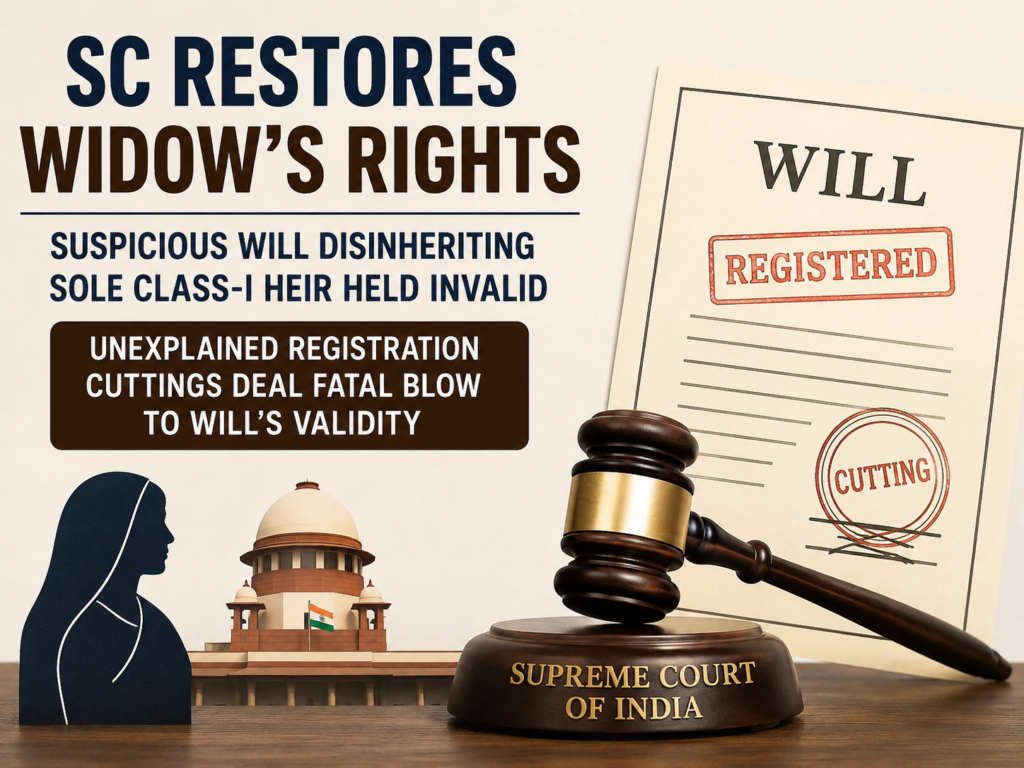
In a significant judgment reaffirming the strict standards governing proof of Wills, the Supreme Court has restored the decree in favour of a widow after holding that a registered Will allegedly executed by her deceased husband could not be accepted merely because one attesting witness proved its execution.
The Court ruled that registration of a Will does not automatically prove its genuineness, particularly when it is surrounded by suspicious circumstances. The propounder of the Will bears the burden of removing every legitimate suspicion to satisfy the judicial conscience of the Court.
The decision is particularly important for succession disputes involving disinheritance of natural heirs.
Background of the Dispute
Chhajju Ram, an illiterate agriculturist, died without children in 1992.
His widow, Bhambo Devi, claimed ownership over his entire property as his sole Class-I legal heir under intestate succession.
However, the defendants relied upon a registered Will allegedly executed in 1974, claiming that Chhajju Ram had bequeathed his entire estate to them.
The widow challenged the Will, alleging that:
- her husband never executed such a Will;
- the document was forged;
- it was surrounded by suspicious circumstances; and
- there was absolutely no reason to deprive her of inheritance.
The Trial Court and the First Appellate Court accepted her case.
The High Court reversed these findings in second appeal.
The matter ultimately reached the Supreme Court.
Issues Before the Supreme Court
The Court examined four principal questions:
- Whether the widow’s pleadings challenging the Will were legally sufficient.
- Whether failure of the widow to enter the witness box defeated her claim.
- Whether the Will was surrounded by suspicious circumstances.
- Whether the High Court exceeded its jurisdiction under Section 100 CPC by reversing concurrent findings of fact.
Supreme Court’s Observations
Burden of proving a Will always lies on its propounder
The Court reiterated a well-settled principle:
A Will is unlike an ordinary document.
Its execution must not merely satisfy the technical requirements of Sections 63 of the Indian Succession Act and 68 of the Evidence Act.
The Court must also be satisfied that:
- the testator understood the contents,
- acted voluntarily,
- executed the Will freely, and
- the document truly represented his testamentary intention.
Where suspicious circumstances exist, the burden shifts entirely upon the propounder to remove those suspicions.
Registration of a Will is not conclusive proof
One of the most significant findings of the judgment is that:
Registration cannot cure suspicious circumstances surrounding execution of a Will.
Although registration lends authenticity to a document, it cannot validate a Will where serious doubts remain unexplained.
The Court observed that registration is only one circumstance among many.
It does not replace proof of genuineness.
Disinheriting the only Class-I heir raised serious suspicion
The Supreme Court observed that:
The widow had lived with the deceased throughout his life.
Evidence showed she cared for him until his death.
There was no evidence of strained relations.
Despite this, the alleged Will completely excluded her inheritance while benefiting persons who were neither close relatives nor Class-I heirs.
The explanation in the Will merely stated that the widow already possessed jewellery and cash.
The Court found this explanation wholly inadequate because:
- no particulars of the alleged jewellery or cash were given;
- no provision was made for her maintenance;
- evidence showed she was actually caring for the deceased.
The Court held that such exclusion created a genuine suspicious circumstance which remained unexplained.
Registration cuttings became the fatal defect
Perhaps the most remarkable aspect of the judgment concerns the registration endorsement.
The reverse side of the Will contained multiple cuttings.
Originally, the name “Laxmi Kant” appeared in the endorsement.
Later, it had been struck off and replaced with “Chhajju Ram.”
Similar alterations also appeared regarding:
- father’s name,
- age,
- identifying particulars.
The Supreme Court noted:
- none of the cuttings bore the initials of the Sub-Registrar;
- no explanation was offered;
- the Sub-Registrar was never examined;
- the surviving attesting witness gave no explanation;
- even official registration records were never produced.
These unexplained alterations seriously undermined the credibility of registration itself.
The Court agreed with the Trial Court that these cuttings constituted one of the strongest suspicious circumstances surrounding the alleged Will.
One attesting witness may satisfy Section 68—but not judicial conscience
The defendants argued that since one attesting witness had proved execution, the statutory requirements stood fulfilled.
The Supreme Court rejected this simplistic approach.
The Court explained that:
Compliance with Section 68 of the Evidence Act is merely the first step.
Where suspicious circumstances exist, proof of attestation alone is insufficient.
The propounder must further satisfy the Court that the Will genuinely represents the free and conscious act of the testator.
Non-examination of the widow was not fatal
The respondents argued that the widow never entered the witness box.
The Court disagreed.
Her claim rested upon admitted facts:
- she was the lawful wife;
- the deceased died childless;
- she was the only surviving Class-I heir.
These facts were never specifically denied.
Therefore, under the doctrine of non-traverse, they stood admitted.
Consequently, the burden remained on the defendants to establish the Will.
High Court exceeded its jurisdiction under Section 100 CPC
The Supreme Court held that:
The Trial Court and First Appellate Court had concurrently recorded findings of fact after appreciating evidence.
The High Court, while exercising jurisdiction under Section 100 CPC, was not justified in re-appreciating evidence merely because another view was possible.
Since the lower courts had correctly identified unexplained suspicious circumstances, the High Court ought not to have interfered.
Final Decision
The Supreme Court:
- Allowed the appeal.
- Set aside the judgment of the High Court.
- Restored the judgments of the Trial Court and the First Appellate Court.
- Declared the widow entitled to the property as the sole legal heir.
- Held that the alleged registered Will was not proved.
Important Legal Principles Emerging from the Judgment
The judgment reinforces several important principles governing testamentary succession:
- Registration alone does not establish the genuineness of a Will.
- Proof under Section 68 of the Evidence Act is only one stage of proving a Will.
- The propounder must remove every legitimate suspicious circumstance.
- Unexplained exclusion of a natural heir may itself become a suspicious circumstance.
- Alterations in registration endorsements require satisfactory explanation.
- Judicial conscience must be fully satisfied before accepting a Will.
- Concurrent findings regarding suspicious circumstances should ordinarily not be disturbed in second appeal under Section 100 CPC.
Why This Judgment Matters
This decision is likely to become an important precedent in Will disputes across India.
It sends a clear message that:
A registered Will is not immune from judicial scrutiny.
Courts will carefully examine:
- the fairness of the disposition,
- surrounding circumstances,
- conduct of beneficiaries,
- credibility of witnesses,
- authenticity of registration,
- and every unexplained irregularity before accepting a testamentary document.
The judgment also provides significant protection to surviving spouses and other natural heirs against suspicious testamentary claims supported only by formal compliance with statutory requirements.
Key Takeaways
✔ Registration does not validate a suspicious Will.
✔ The burden to prove a Will always remains on its propounder.
✔ Excluding a sole Class-I heir without convincing reasons may itself be a suspicious circumstance.
✔ Courts must be satisfied not merely about execution, but about the genuineness of the testator’s free intention.
✔ Unexplained alterations in registration records can seriously undermine the validity of a Will.
✔ High Courts exercising jurisdiction under Section 100 CPC should not lightly interfere with concurrent factual findings regarding suspicious circumstances.
Case: Sardari Lal v. Bishan Dass & Ors.
Citation: Civil Appeal No. 10990 of 2016
Court: Supreme Court of India
Bench: Justice Manoj Misra
Date of Judgment: 6 July 2026
Statutes Involved
- Indian Succession Act, 1925 – Section 63
- Indian Evidence Act, 1872 – Section 68
- Registration Act, 1908 – Sections 34, 35, 58 to 60
- Code of Civil Procedure, 1908 – Section 100
Disclaimer: This article is intended solely for legal awareness and educational purposes. It provides a summary and analysis of the Supreme Court’s judgment in Sardari Lal v. Bishan Dass & Ors., Civil Appeal No. 10990 of 2016 (Judgment dated 6 July 2026). It does not constitute legal advice. Readers should refer to the full judgment and consult a qualified legal professional before acting on any legal issue.
About The Author



More Stories
SC: Assessment Committee Not Bound to Average APR/PMS and Work Report Marks for Promotion
Supreme Court Quashes Advocate’s Blacklisting in IBA Caution List: Banks Cannot Punish Lawyers for Alleged Professional Negligence
Default Bail Under BNSS: Non-Supply of Chargesheet Copies Does Not Confer Statutory Bail